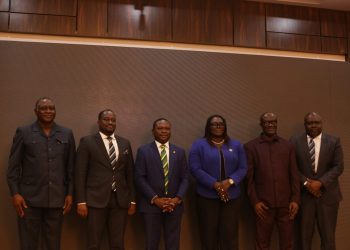
President John Dramani Mahama has received the Final Recommendations of the Constitutional Review Committee (CRC), a comprehensive report proposing targeted amendments to Ghana’s 1992 Constitution aimed at strengthening governance, accountability, and national development.
The report, titled “Transforming Ghana: From Electoral Democracy to Developmental Democracy,” represents the outcome of an extensive national consultation process involving citizens, civil society organisations, experts, traditional authorities and public institutions. The Committee’s work was guided by the principle of preserving Ghana’s democratic stability while addressing structural challenges that have emerged over more than three decades of constitutional practice.
According to the CRC, Ghana’s record of peaceful elections and orderly political transitions has not consistently produced the level of economic transformation and public service delivery expected by citizens. The Committee therefore proposes a set of reforms intended to improve the effectiveness of state institutions without undermining the democratic gains achieved under the Fourth Republic.
Executive Authority and the Cost of Government
Among the notable proposals are measures to rationalise the size and operation of the Executive. The Committee recommends limiting the total number of Ministers of State, including deputy and regional ministers, to a maximum of 57, based on the existing constitutional cap of 19 Cabinet ministers. It further proposes that Deputy Regional Minister positions be discontinued.
The CRC argues that these measures would help contain the cost of government and promote greater efficiency in executive administration. To reinforce parliamentary oversight, the Committee also recommends that a minister who is censured by Parliament should be removed from office and barred from reappointment for the remainder of the term in which the censure occurs
Public Appointments and Institutional Independence
The report proposes a clearer constitutional framework for public appointments, distinguishing between executive, independent and hybrid offices. Under the proposed model, appointments to independent constitutional bodies would be based on competitive, merit-driven processes led by constitutionally mandated institutions, rather than relying primarily on presidential discretion.
The Committee states that this approach would promote professionalism and reduce perceptions of politicisation in key state institutions, while preserving the President’s authority to appoint officials who directly serve the executive function of government.
Local Governance and Decentralisation
On decentralisation, the CRC revisits longstanding issues surrounding the election and accountability of Metropolitan, Municipal and District Chief Executives (MMDCEs). The report recommends clearer constitutional guidance on whether and how MMDCEs should be elected, the role of political parties in local government, and the appropriate qualifications and term limits for local executives.
The Committee also proposes reforms to fiscal decentralisation, including improved management of the District Assemblies Common Fund and internally generated funds, with the aim of strengthening local accountability and service delivery.
Judicial Structure and Independence
Judicial reforms form a central component of the CRC’s recommendations. The Committee proposes restructuring the Supreme Court into two permanent divisions—one dedicated to original jurisdiction, particularly constitutional interpretation, and another focused on appellate matters.
In addition, the CRC recommends a single, non-renewable 10-year term for the Chief Justice, alongside decentralisation of administrative authority within the judiciary. These measures, the report notes, are intended to safeguard judicial independence, enhance efficiency, and promote public confidence in the justice system.
Institutions of Accountability
To strengthen accountability, the CRC recommends the establishment of a constitutionally entrenched Anti-Corruption and Ethics Commission. The proposed body would consolidate and reinforce existing anti-corruption efforts, supported by clearer enforcement mechanisms and sanctions.
The Committee also recommends reforms to the Council of State, retaining the institution but redefining its role to provide more substantive oversight and to act as a co-guarantor of the independence of key constitutional offices, rather than functioning primarily as an advisory body
State-Owned Enterprises are similarly addressed, with proposals to formally recognise directors and officers as fiduciaries of the State. The report calls for legislation allowing citizens to pursue public-interest and derivative actions against SOE officials for misconduct or abuse of office, subject to defined legal safeguards.
Land Administration and Natural Resources
The CRC devotes significant attention to land governance and natural resource management. It proposes explicit constitutional fiduciary duties for public authorities involved in land administration, supported by mandatory audits, public land registers and enhanced parliamentary oversight.
On compulsory land acquisition, the Committee recommends stricter conditions to ensure acquisitions serve clearly defined public purposes, with compensation fully secured and paid within prescribed timelines. Failure to meet these conditions, the report suggests, should render such acquisitions void.
The report also proposes the establishment of a Natural Resource Commission to coordinate policy and regulatory decisions across sectors, as well as measures to increase Ghana’s benefit from extractive industries and protect resource revenues for future generations.
Rights, Inclusion and Social Protection
The CRC recommends targeted amendments to expand and clarify constitutional protections for women, children and vulnerable groups. These include provisions on gender equality, affirmative action, protection against gender-based violence, and recognition of emerging digital privacy rights.
The Committee emphasises that these proposals are intended to align constitutional protections with contemporary social realities while remaining consistent with Ghana’s constitutional traditions
Consultative Process
The Committee’s work was informed by extensive public engagement. It received 785 written submissions and engaged more than 21,500 citizens through zonal forums, stakeholder meetings and digital platforms. Engagements included traditional leaders, professional bodies, youth groups, security agencies and political actors from across the spectrum.
In submitting the report, the CRC reiterated that its recommendations were developed without regard to partisan advantage and were guided solely by considerations of national interest and constitutional improvement.
The proposals now await consideration by the President and, subsequently, Parliament, where decisions on implementation and possible constitutional amendments will be subject to further debate and consensus-building within Ghana’s democratic framework.