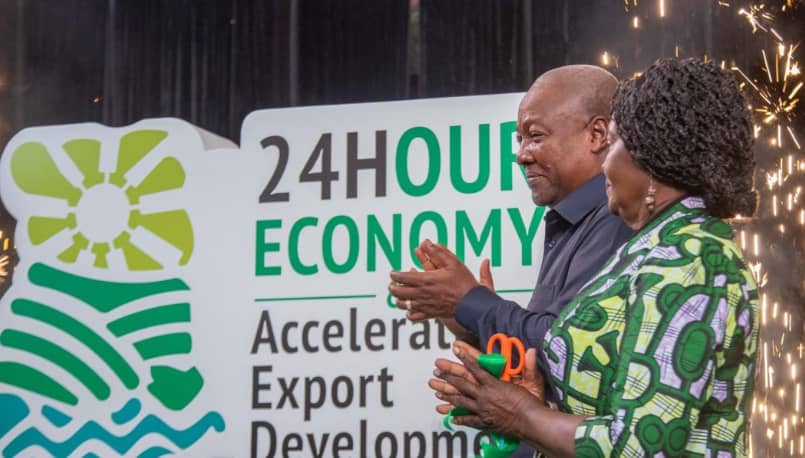
The Institute for Liberty and Economic Education (ILEE) has mounted a sharp critique of the newly signed 24-Hour Economy Authority Bill, describing it as an unnecessary expansion of state power that risks suffocating private enterprise under layers of bureaucracy.
In a statement issued following the February 19, 2026 assent to the bill, the policy think tank said the initiative, though marketed as a bold step toward industrialisation, represents “a classic example of bureaucratic mission creep.”
“To the casual observer, the idea of a ‘Ghana that never sleeps’ is an attractive one,” ILEE noted. “However, for those of us… who study the long-term effects of state expansion, this new Authority is a classic example of ‘bureaucratic mission creep.’ By creating a new government office to ‘manage’ the economy, the state is once again choosing the heavy hand of central planning over the invisible hand of the free market.”
The group challenged the central argument advanced by proponents of the policy—that a new Authority is needed to ensure coordination across sectors such as tax administration, security and power supply.
“In economic reality, ‘coordination’ is often a polite word for more red tape,” the statement said, pointing to existing institutions such as the Ministry of Trade and Industry, the Ghana Investment Promotion Centre (GIPC), and the Ministry of Employment. Creating another body with its own Chief Executive and board, it argued, “does not streamline the economy; it simply adds a new gatekeeper who must be satisfied before a business can innovate.”
According to ILEE, the risk is regulatory duplication that shifts entrepreneurs’ focus from customers to compliance. It cited the example of a shop owner in Kumasi who, instead of responding directly to market demand by extending business hours, may now have to navigate “registration protocols” in Accra to prove they are “24/7 Ready.”
“The most dangerous premise of this bill is that a 24-hour economy can be ‘authority-led’ rather than ‘demand-led,’” the institute stressed. “Economic activity is a response to price signals.”
ILEE further warned that empowering the Authority to “grant” incentives and “identify” sectors effectively positions government as arbiter of winners and losers. Its research, the group said, shows that “targeted tax rebates managed by a central body inevitably favor large, politically connected firms that have the legal teams to navigate the application process,” leaving small-scale manufacturers disadvantaged while still contributing taxes to fund what it estimates as a GH₵100 million budget allocation for the Authority.
The institute also questioned the fiscal prudence of establishing a new bureaucracy at a time when the 2026 Budget targets a primary surplus to stabilise national debt.
“Every new government office requires vehicles, office space, ‘stakeholder engagement’ budgets, and salaries. This is capital that is ‘crowded out’ of the private sector,” it argued.
Instead of financing a new secretariat, ILEE proposed channeling equivalent resources into public goods such as street lighting, police patrols and broad-based corporate tax reductions. “A 24-hour economy requires a ‘system readiness’ that comes from infrastructure, not from a new group of civil servants,” the statement said.
Calling for what it described as “radical deregulation,” the institute outlined key conditions for a sustainable round-the-clock economy: lower general tax burdens, labour law flexibility to enable shift work, and improved security to ensure workers are safe “at midnight as they are at noon.”
ILEE maintained that “economic transformation is not found in the signature of a bill or the hiring of more civil servants; it is found in the freedom of the Ghanaian entrepreneur to innovate without permission.”
“The ‘24-Hour Economy Authority’ is a solution looking for a problem,” the statement furthered, urging policymakers to “shrink the state and grow the citizens” if genuine economic renewal is to be achieved.