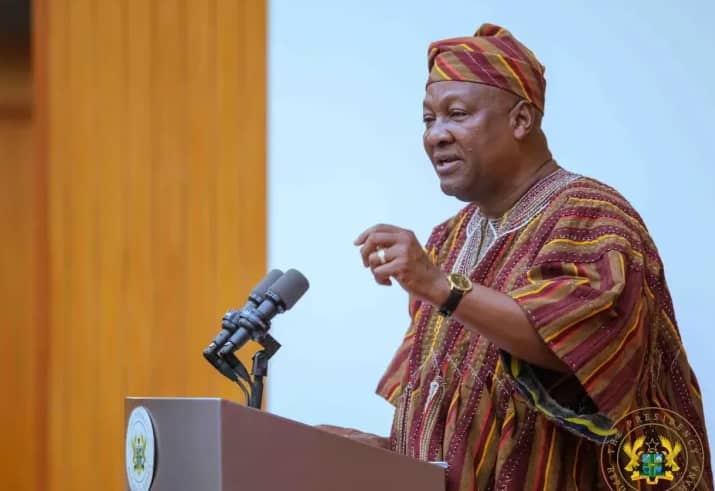
A leading policy think tank has cautioned that Ghana’s celebrated macroeconomic rebound under President John Dramani Mahama may be built on fragile foundations, warning that the country risks mistaking “windfall stability” for genuine economic transformation.
In a response to the 2026 State of the Nation Address (SONA) delivered by the President last week, the Institute for Liberty and Economic Education (ILEE) acknowledged what it described as a “remarkable turnaround” from the fiscal distress of 2024, citing that inflation has cooled to 3.8%, the cedi has appreciated by 40.7%, reserves have climbed to $13.8 billion, and Ghana’s GDP is projected at $113.5 billion.
But the group insists that deeper structural issues remain unresolved.
“Stability is not transformation,” the policy paper states, arguing that much of the current fiscal breathing room has been driven by high global commodity prices and state-managed reserve accumulation through the Ghana Gold Board (GoldBod), rather than a diversified, private-sector-led expansion.
ILEE describes the current moment as one of “crisis exit competence” — but not yet the dawn of a prosperous society.
Cost of Capital ‘Still a Suffocation Tax’
Despite the macroeconomic gains, the group says high borrowing costs continue to choke entrepreneurship. With the Monetary Policy Rate at 15.5% and average commercial lending rates hovering above 20%, it argues that Ghanaian businesses remain constrained.
For the ordinary entrepreneur, ILEE notes, access to affordable capital — not headline GDP numbers — will determine whether recovery translates into opportunity.
The group is urging the Bank of Ghana to aggressively reduce the policy rate while stability persists and to shift away from centralized reserve management models toward greater foreign exchange autonomy for private exporters.
24-Hour Economy: Bridge to Jobs or Bureaucratic Trap?
ILEE also took aim at the government’s flagship 24-Hour Economy policy, projected to generate 1.7 million jobs through a newly passed legislative framework.
While the group supports productivity expansion, it warns that the creation of a “24-Hour Economy Coordination Authority” could introduce fresh layers of licensing, fees, and red tape.
“In a free society, economic activity is a spontaneous response to demand, not a scheduled state directive,” the paper argues.
Rather than administrative oversight, ILEE is proposing automatic tax credits for firms that increase third-shift employment, flexible labour regulations to reduce SME hiring risks, and reduced off-peak electricity tariffs to make round-the-clock production financially viable.
Cocoa Price Cut Exposes Structural Weakness
One of the sharpest criticisms focused on the controversial reduction in the cocoa producer price from GH¢3,625 to GH¢2,587, which the government described as necessary to rescue COCOBOD from insolvency.
ILEE argues that the move highlights the risks of monopoly pricing structures, where farmers ultimately shoulder the burden of bureaucratic inefficiencies and debt.
“When the state acts as the sole buyer and price-fixer, the farmer becomes a price-taker,” the paper states, calling for gradual liberalization of the cocoa sector, including permitting private exporters to ship part of their purchases directly.
The group maintains that value addition and genuine “chocolate industrialization” will only flourish under private supply chain control, not state management.
Energy Sector: ‘Black Hole’ of State Debt
While commending the clearance of $1.47 billion in energy sector arrears, ILEE described the sector’s structure as inherently inefficient due to state dominance in generation, transmission, and distribution.
It called for breaking electricity distribution monopolies, enabling retail competition, and allowing independent power producers to sell directly to industrial zones. The think tank also wants all import duties and VAT on solar and battery storage technology suspended for five years to accelerate decentralized energy access.
Anti-Corruption and the Galamsey Question
On governance, ILEE welcomed reported recoveries under the Operation Recover All Loot (ORAL) initiative but stressed that anti-corruption efforts must avoid political selectivity. It said ongoing legal processes involving former officials — including former Finance Minister Ken Ofori-Atta — will test the administration’s commitment to the rule of law.
Regarding illegal mining, or galamsey, the group endorsed targeted states of emergency in ecological hotspots but argued that enforcement alone will fail without secure property rights for local communities and small-scale miners.
“When the state ‘owns’ everything, nobody protects anything,” it said, advocating for formalized, tradable property titles to incentivize environmental restoration.
From Reset to Reform?
The group asserted that President Mahama’s administration has successfully managed Ghana’s “crisis exit,” it risks entrenching a larger state footprint under the banner of recovery.
The think tank warns that new authorities, coordination bodies, and state-managed funds may deepen bureaucratic control rather than unleash private initiative.