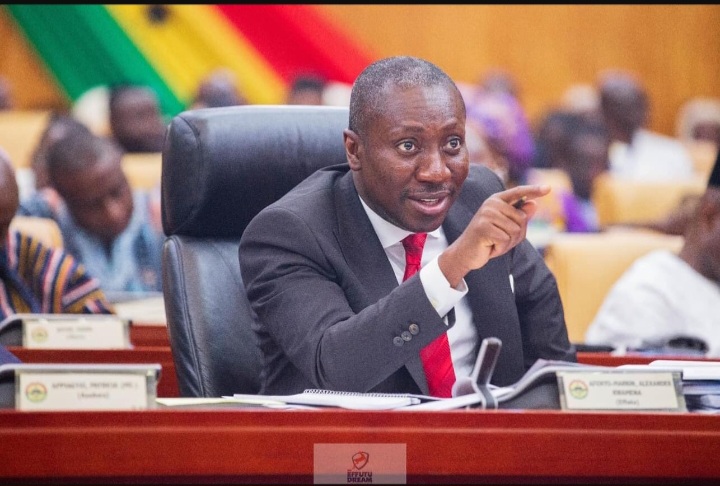
The Minority Caucus of Parliament has challenged the government’s narrative of prudent economic management, arguing that recent macroeconomic stability is largely externally driven and masks deep structural weaknesses in the economy.
Addressing the media at an accountability press conference marking one year of parliamentary scrutiny, the Minority said Ghana’s apparent fiscal recovery is tied almost entirely to the IMF programme and favourable global commodity trends, not domestic economic reforms.
“Ghana’s economic fortune so far is tied to the IMF programme and the windfall, not necessarily due to any re-engineering of the economy,” the Caucus stated.
According to the Minority, fiscal consolidation was achieved through “sharply cut expenditures for critical sectors,” while currency stability resulted largely from a weaker US dollar and increased global investment in gold. They further credited Ghana’s recent trade surplus to debt restructuring initiated under the previous administration and a boom in gold and cocoa exports.
The Minority cited the $3 billion IMF programme secured in May 2023, which unlocked debt relief and financing, including a $2.8 billion restructuring deal approved by Parliament in mid-2025 with 25 official creditors. “All debt payments due through 2026 were rescheduled, effectively granting Ghana $2.8 billion in debt service relief it could play with in the budgets,” they said.
Despite declining inflation figures, the Caucus warned that macroeconomic gains are disconnected from lived realities. “Inflation fell on paper, but the cost of a simple meal remained beyond reach for many families,” the Minority noted, adding that about 1.25 million young people remain outside employment, education, or training.
They accused government of replacing the scrapped e-levy with heavier utility and energy charges. “They took away e-levy at 1.5 percent, but electricity tariffs have gone up in excess of 27 percent,” the Minority said, describing this as “NDC hypocrisy.”
The Caucus warned that the current stabilization, built on IMF conditionalities, new levies, and narrow commodity exports, represents “a postponement of crisis wrapped in a polished statement,” urging structural reforms in energy, agriculture, and job creation to secure long-term resilience.