Ghana’s services sector accounted for nearly 70 per cent of the country’s economic growth in August 2026, highlighting its dominant contribution to economic activity, according to Government Statistician, Dr Alhassan Iddrisu.
The sector contributed 69.9 per cent of the 6.8 per cent growth recorded during the month, significantly outpacing industry and agriculture.
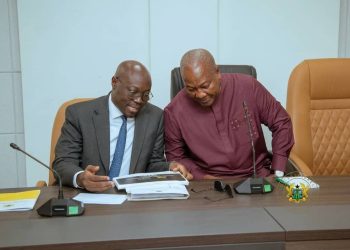
Presenting the latest Monthly Indicator of Economic Growth (MIEG) on Wednesday, November 11, 2026, Dr Iddrisu said the economy expanded by 6.8 per cent in August 2026, up from 5.3 per cent in the corresponding period of 2025.
The MIEG index, which measures changes in economic activity after accounting for price changes, increased to 115.4 in August 2026 from 108.0 a year earlier.
Highlighting the contribution of the various sectors, Dr Iddrisu said services remained the largest driver of economic expansion.
“Of all the extra economic activity Ghana produced this August, compared with August last year, almost 7 out of every 10 parts came from one sector, services,” he stated.
A breakdown of the sectoral contributions showed that services accounted for 69.9 per cent of growth, followed by industry at 21.2 per cent and agriculture at 6.8 per cent. Net indirect taxes contributed the remaining 2.1 per cent.
The services sector recorded growth of 10.7 per cent in August 2026, compared with 7.1 per cent in August 2025, with information and communication identified as its leading driver.
Industry also recorded an improvement, expanding by 4.5 per cent, compared with 0.8 per cent in the corresponding period last year, largely driven by manufacturing.
Agriculture, however, experienced a slowdown, recording growth of 2.6 per cent, down from 8.6 per cent in August 2025, with crops remaining the leading contributor to activity within the sector.
The figures indicate that while services continue to provide the largest share of Ghana’s economic expansion, the industrial sector is also showing improved performance, particularly in manufacturing.
Explaining the relationship between the MIEG and the quarterly Gross Domestic Product (GDP), Dr Iddrisu said the monthly indicator provides an early assessment of economic performance.
“When we average the monthly figures, the MIEG matches GDP closely,” he explained.
He noted that both the MIEG and GDP recorded growth of 6 per cent in the second quarter of 2026.
For July and August combined, the MIEG indicated growth of 6.9 per cent, providing an early indication of economic performance in the third quarter.
The official GDP figures for the third quarter are expected to be released in the second week of December 2026.