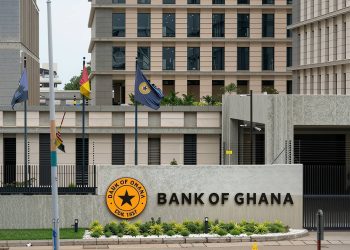
The Bank of Ghana (BoG) has reduced its Monetary Policy Rate (MPR) from 14% to 11%, representing a 300-basis-point cut, as it moves to adjust its monetary policy stance amid improving domestic economic conditions.
The decision was announced in a press release dated November 18, 2026, following the 133rd meeting of the Monetary Policy Committee (MPC), held from November 16 to 18.
The Committee also announced additional reforms to its monetary operations framework, including replacing the 14-day Open Market Operations (OMO) instrument with a seven-day instrument and narrowing the monetary policy corridor from ±400 basis points to ±100 basis points around the policy rate.
The latest adjustment follows improvements in domestic economic activity, easing interest rates, stronger private sector credit growth and better fiscal performance, although inflation rose slightly in October.
Headline inflation increased to 5.5% in October 2026 from 5.2% in September, driven mainly by non-food inflation, which rose to 7.9% from 6.2%, reflecting higher utility tariffs and elevated crude oil prices.
Food inflation, however, declined to 2.8% from 4.0%, supported by improved food supply conditions. The Bank’s core inflation measure, which excludes energy and utility prices, also edged up to 5.2% from 5.0%.
Despite the increase, inflation remained below the lower bound of the medium-term target, while inflation expectations among consumers, businesses and the banking sector remained anchored within the target band.
The Committee noted that recent reforms to the Bank’s monetary operations framework had strengthened liquidity management and improved the transmission of monetary policy signals to money market rates.
It said prevailing market rates had been trading below the existing policy rate, indicating that the effective monetary policy stance was lower than the announced rate, a development that informed the latest adjustment.
Economic activity remained strong, with the Composite Index of Economic Activity (CIEA) growing by 17.7% year-on-year in September 2026, compared with 9.6% in September 2025.
The growth was supported largely by private sector credit, exports, tourist arrivals and construction activity.
Interest rates also declined significantly over the period. The yield on the 91-day Treasury bill fell to 4.6% in October 2026 from 10.6% a year earlier, while banks’ average lending rate declined to 15.8% from 22.2%.
The easing interest rate environment contributed to increased credit demand, with private sector credit growth rising to 37.2% from 13.9%. In real terms, credit to the private sector expanded by 30.0%, compared with 5.4% over the same period last year.
On the fiscal front, provisional data for the first ten months of 2026 showed an overall deficit of 1.0% of Gross Domestic Product (GDP) on a commitment basis, below the target of 3.0%.
The primary balance recorded a surplus of 1.4% of GDP, putting the government on track to achieve its full-year target of 1.5%, largely on the back of fiscal prudence and effective public debt management.
However, public debt increased to GH¢759.3 billion, equivalent to 47.5% of GDP, at the end of October 2026, from GH¢641.1 billion, or 44.7% of GDP, at the end of December 2025.
The banking sector remained solvent, profitable and liquid, with total assets increasing by 21.2% year-on-year to GH¢512.9 billion. The Capital Adequacy Ratio improved to 18.5% from 17.9%, while the Non-Performing Loan ratio declined to 13.1% from 19.5%.
The external sector also recorded improvements, with the trade surplus rising to US$13.0 billion between January and October 2026, from US$8.7 billion during the same period in 2025. Gold accounted for approximately 67% of total export earnings.
Gross International Reserves, however, declined to US$12.1 billion as of November 17, 2026, representing 4.4 months of import cover, from US$13.8 billion, or 5.7 months of import cover, at the end of December 2025.
The MPC said the economy had recorded significant improvements, with growth remaining firm, credit conditions easing, fiscal consolidation progressing and the external sector providing buffers against shocks.
It expects inflation to gradually return to the target range over the medium term but warned that risks from crude oil prices, El Niño-related threats to food production and utility tariff adjustments could affect the outlook.
The next MPC meeting is scheduled for January 18 to 20, 2027, with the policy decision expected to be announced on January 20.