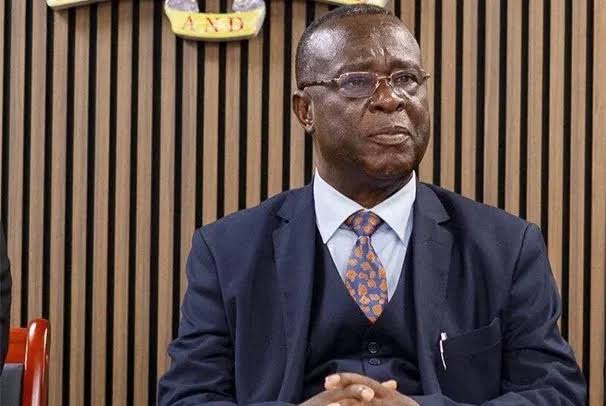
The Chief Justice, Justice Paul Baffoe-Bonnie, has called for independent and rigorous scholarly examination of Supreme Court decisions, saying judicial authority should not shield judgments from critical analysis.
He said constructive criticism of judicial decisions was necessary to strengthen the administration of justice, improve legal reasoning and support the development of Ghanaian jurisprudence.
“The judicial rule may confer authority to decide. It does not confer immunity from reason,” Justice Baffoe-Bonnie said on Tuesday, October 20, 2026, at the University of Ghana School of Law in Accra.
He was speaking at the launch of the Ghana Supreme Court Review and the University of Ghana School of Law (UGSoL) Book Series, which began with the publication of Administrative Law in Ghana.
The Chief Justice observed that public discussions of court decisions in Ghana often centred on which party won or lost, with judgments frequently interpreted through partisan political considerations rather than examined for their legal and constitutional implications.
“In Ghana, we play football of MPP and NDC. A judgment is delivered, political interpretations are offered, and public discussion ends where serious legal inquiry ought to begin,” he said.
He urged scholars to look beyond the identities of parties and the popularity of outcomes to examine the legal principles established by judgments, their consistency with the Constitution and existing precedents, and their implications for future cases.
Justice Baffoe-Bonnie said a strong judiciary required a strong legal academy capable of examining judicial decisions fairly and independently.
He welcomed the establishment of the Ghana Supreme Court Review, describing it as an opportunity for academics, legal practitioners and other scholars to contribute to the development of the law through evidence-based analysis.
“The finest contribution a scholar can make to the court will sometimes be to demonstrate that the court has erred. And the finest response a court can make to such criticism is not indignation but reflection,” he said.
He added that disagreements among lawyers, judges and scholars were part of the process through which legal principles were tested and refined.
The Chief Justice also underscored the importance of administrative law, which he said deserved greater attention in Ghana’s legal scholarship.
While constitutional law establishes the framework of state authority, he explained, administrative law examines how public power is exercised and whether decisions by public authorities comply with the requirements of legality, fairness and accountability.
He cited Article 23 of the 1992 Constitution, which requires administrative bodies and officials to act fairly and reasonably, and Article 296, which regulates the exercise of discretionary power to prevent arbitrariness, caprice and bias.
Justice Baffoe-Bonnie illustrated the practical importance of administrative law with a case involving 13 students of Notre Dame Secondary School in Navrongo whose examination results were cancelled and who were barred from sitting examinations for three years without being given a proper opportunity to respond to the allegations.
He said the Supreme Court intervened to uphold the principles of natural justice, demonstrating how administrative decisions could affect the future and opportunities of ordinary citizens.
“Behind every administrative decision lies the human consequence,” he said, noting that decisions involving examination results, employment and the exercise of discretion could have lasting effects on individuals and families.
He commended the University of Ghana School of Law for producing locally grounded legal scholarship, saying Ghana’s legal education should explain the country’s institutions and legal experiences rather than depend predominantly on materials developed in other jurisdictions.
The Chief Justice urged students and young lawyers not to limit their intellectual interests to constitutional litigation that attracts public attention, but also to recognise the importance of less-publicised legal work that protects citizens against unlawful administrative decisions.
He said the development of the law was a shared responsibility involving judges, lawyers, legislators, administrators and scholars.
The initiative, led by the University of Ghana School of Law, is intended to provide platforms for sustained examination of Supreme Court jurisprudence and the publication of authoritative legal works grounded in Ghanaian experiences.