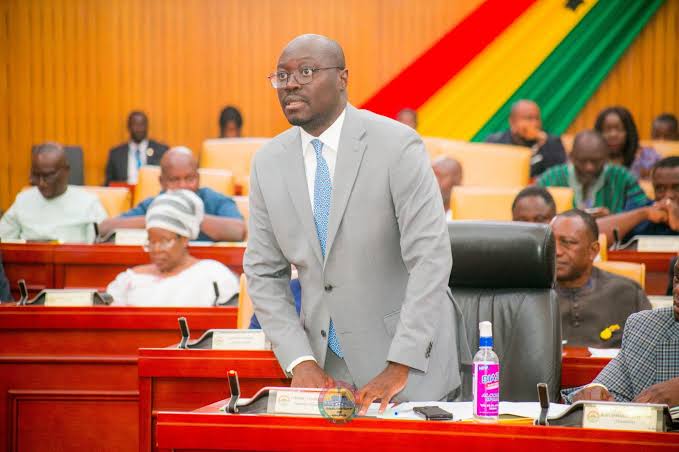
Ghana’s 2026 Mid-Year Fiscal Policy Review focused heavily on fiscal consolidation, infrastructure investment, debt management and macroeconomic stability, but left several flagship government policies and key sectors unaddressed, according to an analysis of Finance Minister Dr. Cassiel Ato Forson’s statement to Parliament.
While the review highlighted progress in inflation reduction, revenue mobilisation, the Big Push Infrastructure Programme, energy sector reforms, and economic growth, several prominent policy initiatives that have featured prominently in the government’s agenda received little attention or were not addressed at all.
24-Hour Economy Absent
One of the most notable omissions was the government’s flagship 24-Hour Economy initiative.
The phrase “24-Hour Economy” did not appear anywhere in the Minister’s address, despite the policy having been presented as a central pillar of the government’s economic transformation agenda.
Instead, the Minister made only a brief reference in his concluding remarks to a broader “New Economy agenda” that would be unveiled at a later date. However, the speech contained no implementation updates, budgetary allocations, institutional framework or timelines relating specifically to the 24-Hour Economy initiative.
The omission leaves unanswered questions about the programme’s current implementation status and financing arrangements.
No Dedicated Focus on Creative Arts, Tourism or Hospitality
The review also contained no specific measures targeting Ghana’s creative arts, tourism and hospitality sectors.
Unlike previous fiscal statements that have often outlined sector-specific interventions, tax reliefs or investment initiatives, the 2026 Mid-Year Review did not announce any new policies or provide operational updates for these industries.
The sectors, widely regarded as significant contributors to employment and foreign exchange earnings, were absent from the Minister’s policy priorities.
Legacy Infrastructure Projects Left Unaddressed
The speech also omitted updates on several inherited public infrastructure projects.
There was no progress report on the completion or operationalisation of Agenda 111 district hospitals. Instead, the Minister referenced “Agenda 111” only as a financial analogy while discussing Ghana’s debt obligations.
“In two years alone, Ghana has to repay GH¢111 billion. Mr. Speaker, this is the true Agenda 111 Ghana must deal with.”
Similarly, the statement did not address the status of E-Blocks or other inherited education and health infrastructure projects.
Infrastructure discussions were instead centred on the government’s Big Push Programme, feeder roads and secondary school improvements being financed under a World Bank-supported initiative.
Housing and Urban Development Receive Limited Attention
Housing policy also featured minimally in the review.
Although the government announced funding for post-flood emergency interventions, drainage improvements and environmental sanitation following recent floods, the statement did not introduce any new affordable housing initiatives or broader urban renewal programmes.
The absence of dedicated housing measures comes amid continued concerns over Ghana’s housing deficit and rapid urbanisation.
Digital Economy Narrowly Framed Around Revenue Collection
Technology featured in the fiscal review primarily as a tool for improving tax administration and domestic revenue mobilisation.
The Minister highlighted initiatives such as Publican AI, Fiscal Electronic Devices and cross-border digital VAT collection.
However, there were no policy announcements relating to broadband expansion, digital infrastructure development, technology entrepreneurship, innovation ecosystems or startup financing.
There was no update on the progress of the government’s One Million Coders Programme aimed at equipping citizens with practical technology skills that improve employability, entrepreneurship and participation in the digital economy.
As a result, the broader digital economy agenda received relatively limited attention beyond tax administration reforms.
Limited Focus on Sports Development
Sports also received little policy attention.
The review recorded an allocation of GH¢58 million for Ghana’s participation in the 2026 FIFA World Cup as part of the government’s expenditure updates.
Beyond that allocation, however, the Minister did not outline any broader sports development strategy, plans for upgrading sporting infrastructure or investment in community sports facilities.
Galamsey Strategy Not Detailed
On illegal mining, commonly known as galamsey, the fiscal review reported that GH¢16 million had been disbursed to the National Anti-Illegal Mining Operations Secretariat (NAIMOS).
However, the statement stopped short of outlining a comprehensive policy strategy for tackling illegal mining, rehabilitating degraded lands or restoring affected water bodies.
Environmental restoration and long-term mining governance reforms were not discussed in detail.
Focus Remained on Fiscal Stability and Infrastructure
Overall, the Mid-Year Fiscal Policy Review concentrated on macroeconomic performance, fiscal discipline, debt servicing, revenue mobilisation and large-scale transport infrastructure.
The government’s Big Push Infrastructure Programme, energy sector reforms, inflation management and economic recovery dominated the Minister’s presentation, while several flagship policy initiatives and sector-specific programmes remained absent or received only passing mention.
Although a mid-year budget review is primarily intended to assess fiscal performance and implementation, the omissions are likely to fuel public interest in whether updates on these initiatives will be provided through subsequent policy announcements or sector-specific engagements.
Already, the Minority in Parliament has criticised the Finance Minister for failing to address several key policy initiatives in the review, arguing that their omission is evidence that those policies have failed.