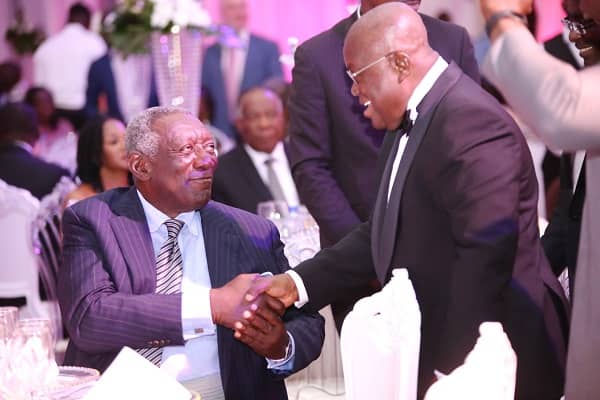
Former President John Agyekum Kufuor has attributed the New Patriotic Party’s (NPP) defeat in the 2024 general elections to several unpopular policy decisions taken under the administration of President Nana Addo Dankwa Akufo-Addo.
In a forthright conversation on The Delay Show, aired on TV3 on Saturday, December 6, 2025, Mr. Kufuor said some of the choices made in the latter years of the Akufo-Addo government were “not understandable” from his perspective.
Mr. Kufuor explained that although the Akufo-Addo administration began strongly in 2017, particularly in its handling of the COVID-19 pandemic, it later made decisions he found questionable.
“After the COVID-19 pandemic, I could not understand some of the decisions taken, including the bond market issues, PDS, and the National Cathedral project, which has still not been completed,” he said.
He pointed to the Domestic Debt Exchange Programme (DDEP), the Power Distribution Services (PDS) deal, and the management of the bond market as policies that undermined public confidence. The National Cathedral project, he stressed, was a major turning point, describing it as a project that shifted from being portrayed as privately funded to becoming a state liability.
“Apartments that housed judges and others were demolished for the National Cathedral, yet it remains unfinished,” he noted, adding that he initially thought the project was “a private enterprise.”
The former president also revealed that he was left out of consultations on key national decisions despite his stature within the party. “I was not consulted, as I did not attend cabinet meetings. I only saw the construction,” he said, adding that he often learned about major developments only by observation.
Reflecting on the NPP’s electoral trajectory, Mr. Kufuor stated that the party’s resounding victory in 2016 was grounded in the achievements of his own administration, which formed the basis of Akufo-Addo’s campaign. “Before the 2016 election in which Akufo-Addo was elected, the campaign was built on my achievements,” he said. “The government started on a good note, but things changed after he assumed power.”
He observed that the tension-filled 2020 election, which resulted in a hung Parliament, and the eventual defeat in 2024 signalled that voters felt alienated by some government actions.
“We won the 2016 elections by a landslide. The 2020 elections were tense and produced a hung Parliament, and the 2024 elections were something else entirely,” he said.
Mr. Kufuor warned that the outcome of the 2024 polls should serve as a lesson. “This shows that the Ghanaian electorate should never be taken for granted. It is a lesson for politicians to be mindful of their actions,” he cautioned.




![Project Finance: Ghana’s Untapped Key to Infrastructure Development [ARTICLE]](https://sikamantimes.com/wp-content/uploads/2026/02/Eunice-Kaanye-350x250.jpeg)