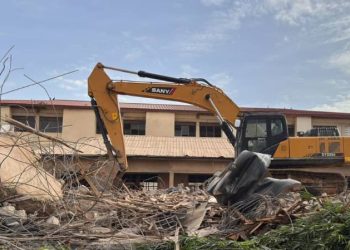
![What Is Seen and Unseen in Ghana’s Inflation “Reset” [ARTICLE]](https://sikamantimes.com/wp-content/uploads/2026/02/Ghana-Inflation-Reset-2026-–-3.8-Inflation-and-Market-Prices-Impact-1.jpg)
By Eric Coffie
The latest report from the Ghana Statistical Service is being hailed by the government as a total economic “reset.” After years of high prices, the “Seen” is undeniable: inflation dropped to 3.8% in January 2026, the cedi has appreciated by nearly 40% over the past year, and the Bank of Ghana has slashed interest rates to 15.5%.
To the average observer, this is a victory. The “Seen” is a stabilized price tag on a bag of rice or a gallon of petrol. But as Bastiat famously warned, a bad economist looks only at the immediate visible effect, while a good economist looks at the series of effects that are “Unseen.”
The government’s narrative focuses on the visible success of the IMF-supported programme. By tightening the money supply and aggressively accumulating $13.8 billion in reserves, the Bank of Ghana has effectively “pinned down” the exchange rate. This has made imports cheaper, which is why food and fuel prices aren’t climbing like they used to. This is the “immediate fruit” that Bastiat spoke of — the sweetness of stability.
The “Unseen”: The Cost of the Anchor
However, every “Seen” benefit has an “Unseen” cost. To achieve this 3.8% figure, the state has had to maintain a “primary surplus” of 1.5% of GDP. In simple terms, this means the government is pulling more money out of the private economy through taxes than it is putting back in.
What is “Unseen” is the capital starvation of the Ghanaian entrepreneur. While the inflation rate is low, the taxes required to maintain the fiscal “anchor” are high. The business that didn’t expand, the youth who weren’t hired, and the local factory that couldn’t compete with cheap imports because of the high cost of local production — these are the hidden casualties of our single-digit success.
The Broken Window of Debt Exchange
Bastiat’s most famous lesson is the “Broken Window Fallacy.” If a boy breaks a window, the “Seen” is the work given to the glazier. The “Unseen” is what the shopkeeper would have bought (perhaps a new suit) if he hadn’t had to fix the window.
Ghana’s debt restructuring was our “Broken Window.” The “Seen” is a lower debt-to-GDP ratio (now around 45%). The “Unseen” is the massive loss of wealth suffered by domestic bondholders and pensioners. The capital that was “broken” to fix the government’s balance sheet is capital that is no longer available to fund private innovation. We are celebrating a repaired window while forgetting the suit that was never bought.
There is another “Unseen” cost taking shape beneath the surface of stabilization: the expansion of the state’s bureaucratic apparatus. For decades, Ghanaian governments of both stripes have sworn by the mantra of a “smaller, more efficient state.” Yet, in practice, the response to economic crisis is rarely downsizing; it is re-regulation. The post-IMF era is witnessing the birth of new agencies, new regulatory bodies, and new layers of oversight, ostensibly designed to prevent a recurrence of the fiscal profligacy that led to the default.
The “Seen” part of this is good governance — a promise that the public purse will be watched. The “Unseen” part is the incremental suffocation of private initiative. Every new layer of bureaucracy, no matter how well-intentioned, creates friction. It creates new forms to fill out, new licenses to acquire, and new officials to pay (or circumvent). This friction acts as a tax on time and innovation. The entrepreneur who must now navigate a more complex regulatory maze to import raw materials or register a new product is an entrepreneur who is spending less time serving customers or improving their business. We risk building an economy that is stable but stagnant, where compliance becomes a more valuable skill than creativity.
A 3.8% inflation rate is a tool, not a destination. Real prosperity is not found in the absence of price increases, but in the presence of productivity. If our single-digit inflation is built on a foundation of high taxes, suppressed demand, and new bureaucracies, it is a fragile peace.
As we applaud the macroeconomic numbers, we must keep our gaze fixed on the microeconomic reality. We must ask not just, “Is inflation low?” but “Is life good? Is work abundant? Is opportunity growing?” The true measure of our economic “reset” will not be found in the headlines of today, but in the unseen ledger of tomorrow — in the businesses that thrive, the innovations that emerge, and the prosperity that is built, not just preserved. To ignore that ledger is to commit the oldest error in economics: mistaking the part for the whole, and the fleeting for the permanent.
Eric Coffie is a free market policy expert and founding president of the Institute for Liberty and Economic Education (ILEE).
DISCLAIMER: The views, comments, and contributions made by readers or contributors on this website do not necessarily represent the position or views of The Sikaman Times. The Sikaman Times will not be responsible or liable for any inaccurate or incorrect statements made by readers or contributors on this website.



![The Future of Non-Profit Funding: Navigating Financial Sustainability in a Shifting Economy [ARTICLE]](https://sikamantimes.com/wp-content/uploads/2026/03/ANPOS-ARTICLE-350x250.jpg)