• About
  • Advertisements
  • Terms of Use
  • Contact
Monday, April 20, 2026
The Sikaman Times
Advertisement
  • Home
  • News
  • Business
  • Technology
  • Regional
  • Features
  • Focus
No Result
View All Result
The Sikaman Times
  • Home
  • News
  • Business
  • Technology
  • Regional
  • Features
  • Focus
No Result
View All Result
The Sikaman Times
No Result
View All Result

Only 1,363 EVs registered as financing, high tariffs slow market – Report

by The Sikaman Times
February 25, 2026
Only 1,363 EVs registered as financing, high tariffs slow market – Report
SharePostSendShareSend

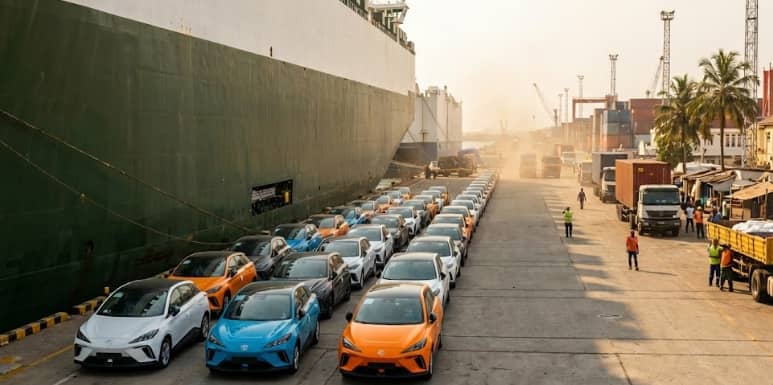
Ghana’s ambitious electric mobility agenda risks stalling unless urgent fiscal and financing reforms are implemented, the latest Ghana Clean Transportation Outlook has cautioned, revealing that only 1,363 electric vehicles (EVs) had been registered nationwide by the end of 2022.

The report paints a stark contrast between policy ambition and market reality. While Ghana’s National Electric Vehicle Policy targets 35 percent EV penetration by 2035 and 70 percent by 2045, current adoption levels remain marginal.

According to the Outlook, approximately 17,660 plug-in EVs were imported between 2017 and 2021, yet actual registrations remain low. Under a Business-As-Usual (BAU) forecast, EV registrations are projected to increase by only 645 additional vehicles by 2040 — a scale described as “insufficient to constitute a viable or transformative e-mobility market.”

“Ghana’s clean transportation transition remains at an early and uneven stage, with limited market scale and weak translation of policy into sustained market outcomes,” the report states.

EVs Taxed Higher Than Petrol Cars

A major barrier, the report finds, is cost — driven largely by fiscal treatment rather than technology limitations.

“All passenger EVs currently attract a uniform import duty of approximately 20 percent,” the report notes, compared to 10 percent for internal combustion engine (ICE) vehicles.

When combined with additional levies — including VAT, NHIL, ECOWAS, AU, and other statutory charges — total tax incidence on EVs can exceed 50 percent of the landed cost.

“This fiscal structure directly undermines EV affordability and market competitiveness,” the report warns, noting that Ghana’s highly price-sensitive vehicle market continues to favor cheaper used petrol and diesel vehicles.

Financing Terms “Suppress Demand”

Beyond taxation, access to credit remains a critical constraint. Interest rates for EV loans range between 15–18 percent for new vehicles and 18–24 percent for used EVs, with repayment tenures typically limited to two to five years.

“Financial institutions often perceive EVs as high-risk assets, citing uncertainties around battery lifespan, resale values, insurance coverage, and long-term maintenance costs,” the report explains.

As a result, EV financing remains largely restricted to formally employed salaried workers, effectively excluding the majority of potential buyers.

Charging Infrastructure Concentrated in Accra

Infrastructure gaps further complicate adoption. As of January 2026, Ghana had only 16 public EV charging stations, with 14 located in Accra, one in Kumasi and one in Takoradi.

Electricity for charging stations is billed under commercial tariffs, a move that erodes the traditional fuel-cost advantage of EVs.

“The absence of a dedicated electricity tariff for EV charging significantly weakens the operating economics of electric mobility,” the report emphasizes.

Private Sector Leading  Without Support

Despite these barriers, the Outlook notes that early market formation is being driven almost entirely by private actors.

“Early adoption across both passenger EVs and electric two- and three-wheelers has been driven by private importers, innovators, and clean energy entrepreneurs, operating in the absence of strong or consistent public incentives,” the report states.

The Chamber is urging government to introduce a 3–5 year time-bound import-duty exemption, implement clear fiscal guidelines announced in the 2024 budget, and introduce electricity tariff relief for EV charging.

Without decisive intervention, the report cautions, Ghana’s electrification roadmap may remain aspirational rather than transformational.


Advertisement Advertisement
Tags: FeaturedGhana Chamber of Clean EnergyGhana Clean Transportation Outlook
Share1Tweet1SendShareSend
Previous Post

Christian Council urges responsible prophecy after conflicting NPP flagbearer predictions

Next Post

What Is Seen and Unseen in Ghana’s Inflation “Reset” [ARTICLE]

Related Posts

MoMo agents reject fraud claims, blame MTN app glitch for account sanctions
Business

MoMo agents reject fraud claims, blame MTN app glitch for account sanctions

April 17, 2026
DVLA interdicts 13, sacks 3 others
Business

Use of fake DV plates to attract arrests, prosecution from May 4 – DVLA

April 17, 2026
Police action against robbers restores confidence among momo agents – MoMAG
Business

Police action against robbers restores confidence among momo agents – MoMAG

April 16, 2026
Power Outage or Dumsor
Business

Gas plant fault responsible for outages – GRIDCo, Ghana Gas

April 16, 2026
NPP: State institutions being used to silence critics
General

NPP: State institutions being used to silence critics

April 16, 2026
Fuel economy tips in the wake of expected global price surge caused by Israel-Hamas war
Business

Fuel price rise: Gov’t to absorb GH¢2.00/l diesel, GH¢0.36/l petrol

April 15, 2026
Next Post
What Is Seen and Unseen in Ghana’s Inflation “Reset” [ARTICLE]

What Is Seen and Unseen in Ghana’s Inflation “Reset” [ARTICLE]

Leave a Reply Cancel reply

Your email address will not be published. Required fields are marked *

  • OSTECH warms up for 33rd anniversary

    OSTECH warms up for 33rd anniversary

    87 shares
    Share 35 Tweet 22
  • MoMo agents reject fraud claims, blame MTN app glitch for account sanctions

    10 shares
    Share 4 Tweet 3
  • Producer Price Inflation declines to 23.1% in December 2024.

    5 shares
    Share 2 Tweet 1
  • Police action against robbers restores confidence among momo agents – MoMAG

    13 shares
    Share 5 Tweet 3
  • Underwater heritage must be recognised in blue economy – UG Lecturer

    7 shares
    Share 3 Tweet 2

Browse by Category

  • Africa
  • Ahafo
  • Art & Entertainment
  • Arts & Entertainment
  • Ashanti
  • Aviation
  • Banking & Finance
  • Bono East
  • Brong Ahafo
  • Business
  • Business
  • Central
  • Communication
  • Culture
  • Eastern
  • Economy
  • Education
  • Entrepreneurship & Local Business
  • Exclude
  • Features
  • General
  • Ghana
  • Greater Accra
  • Health
  • Health
  • International
  • International Trade
  • Lifestyle
  • Lifestyle
  • Media
  • National
  • News
  • North East
  • Northern
  • Oil & Gas
  • Oti
  • Politics
  • Politics
  • Real Estate
  • Regional
  • Relationship
  • Relationship
  • Religion
  • Savannah
  • Social
  • Social
  • Sports
  • Sports
  • Technology
  • Tourism & Hospitality
  • Trade
  • Transportation
  • Uncategorized
  • Upper East
  • Upper West
  • Volta
  • Western
  • About
  • Advertise
  • Privacy & Policy
  • Contact

About Us

© 2022- 2026 The Sikaman Times

No Result
View All Result
  • Home
  • News
  • Business
  • Technology
  • Regional
  • Features
  • Focus

About Us

© 2022- 2026 The Sikaman Times

QUICK LINKS

About

Privacy Policy

Terms Of Use

Advertisement

Contact

FOCUS

Ghana

Africa

International

CATEGORIES

General News

Business

Opinions

Politics

Technology

EXTRAS

Sports

Entertainment

Health & Wellness

STAY CONNECTED

Facebook Twitter Youtube Instagram Linkedin

© COPYRIGHT 2022-2026
The Sikaman Times