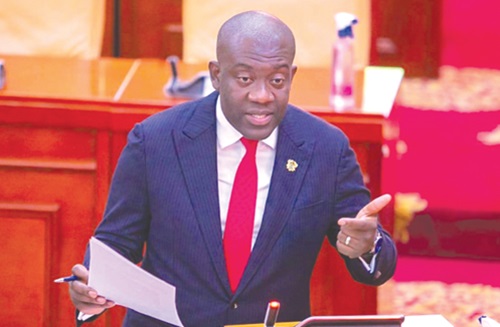
The Minority Caucus in Parliament has launched a blistering critique of the Bank of Ghana’s 2025 audited financial statements, describing them as “an illegality” and accusing authorities of politicising the central bank’s operations in a manner that could undermine its independence and credibility.
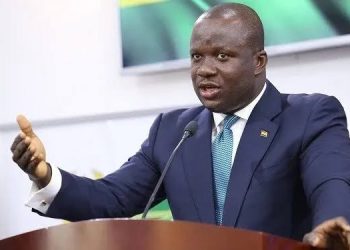
Addressing a press conference on May 3, 2026, former Information Minister and Ranking Member, Kojo Oppong Nkrumah, argued that the presentation of the accounts deviated from established financial reporting norms and masked the true financial position of the central bank.
According to him, the headline loss of GH¢15.6 billion reported by the Bank significantly understates the institution’s actual financial performance.
He contended that when additional losses captured under “other comprehensive income” are included, the central bank’s total loss rises to approximately GH¢34.9 billion—and could reach GH¢44 billion when adjusted for what he described as “artificial revenue” from gold sales.
“The headline loss looks smaller than the underlying economic reality,” he said, insisting that the accounting approach adopted by the Bank allowed key losses to be “buried” outside the main operating statement.
A central plank of the Minority’s argument is the claim that the Bank has, for the first time, slipped into what it termed “policy insolvency”—a condition where internally generated income is insufficient to cover the cost of core monetary policy operations.
Mr. Oppong Nkrumah alleged that this position was concealed through the sale of nearly half of the country’s gold reserves, generating about GH¢9.5 billion in revenue to offset deficits.
“A central bank that needs to sell assets to cover its operations is operating on borrowed time,” he warned.
The Minority further questioned the basis on which the accounts were prepared, citing disclosures within the audit report indicating that the financial statements were compiled using the Bank’s own internal accounting framework rather than full adherence to international standards. They referenced comments by auditors KPMG, which drew attention to the reporting basis, as well as admissions by the Bank’s directors that certain IFRS criteria had not been applied.
Beyond accounting concerns, the Caucus attributed the Bank’s losses to what it described as costly policy reversals, particularly the scrapping of earlier liquidity management measures. These decisions, they argued, led to a surge in sterilisation costs—estimated at over GH¢16 billion—as excess liquidity had to be mopped up at interest.
They also criticised the gold purchase programme, claiming it resulted in losses of about GH¢9 billion for the central bank, while related entities recorded gains.
The Minority raised concerns about the broader economic implications, pointing to what they described as a “wealth transfer” from the public sector to commercial banks. They noted that the Bank reportedly paid over GH¢14 billion in interest on its instruments, coinciding with record profits in the banking sector, while private sector credit growth declined sharply in 2025.
“This is not good monetary policy,” Mr. Oppong Nkrumah said.
“Banks should make profit by supporting businesses, not by earning risk-free returns from the central bank,” he added.
The Caucus also argued that the reported macroeconomic stability has not translated into improved living conditions, citing high cost of living, constrained access to credit, rising youth unemployment, and ongoing challenges in key sectors such as energy and manufacturing.
While stressing that their intervention was not an exercise in political point-scoring, the Minority called for urgent reforms to restore transparency, credibility, and operational independence at the central bank.