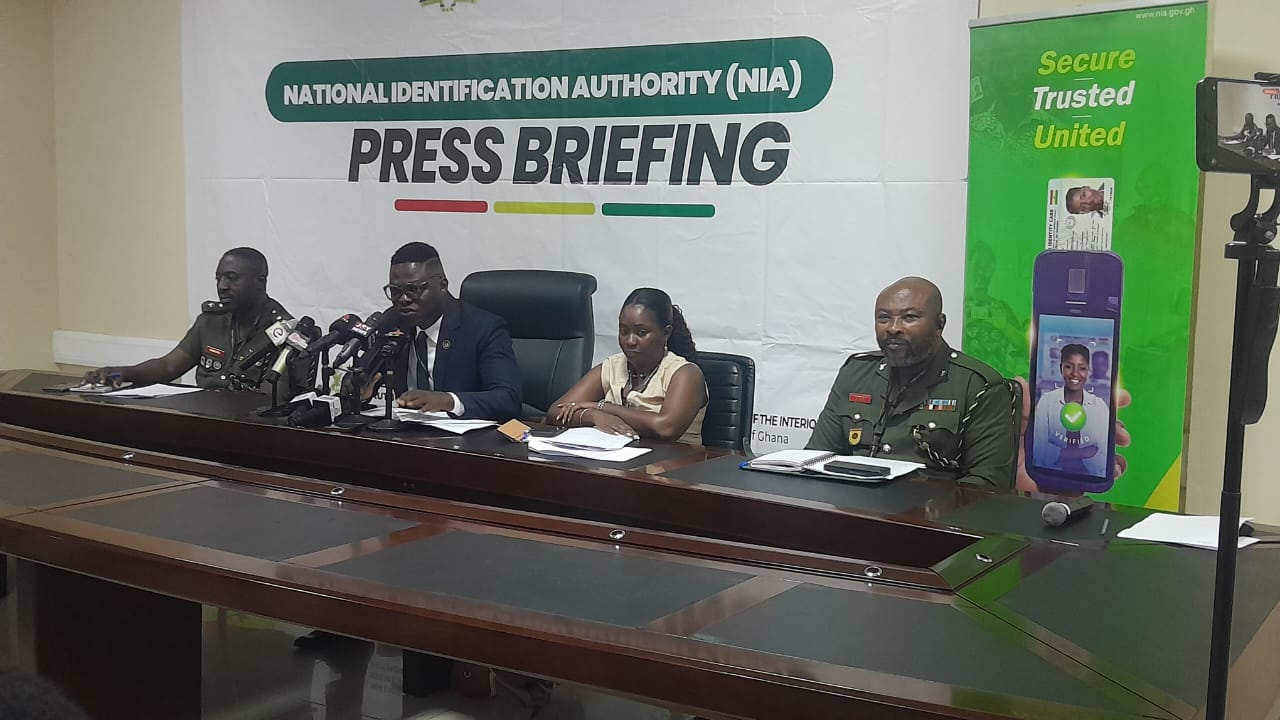
The National Identification Authority (NIA) has warned public and private institutions against engaging third-party intermediaries to access its identity verification platform, cautioning that institutions that violate the regulations risk prosecution and administrative sanctions.
The warning follows the implementation of Legislative Instrument 2523 (L.I. 2523), which regulates the use of the National Identity Register and Ghana Card verification services.
Addressing a press conference on Monday, November 2, 2026, the Head of Corporate Communications at the NIA, Williams Ampomah Emmanuel Darlas, said institutions seeking access to the National Identity Register must engage the authority directly and complete its approved onboarding procedures.
He stressed that the NIA does not authorise intermediaries, resellers or third-party verification providers to onboard institutions onto its platform.
“We are emphatically clarifying that we do not engage third-party verification providers, intermediaries or resellers to onboard institutions onto identity verification system platforms,” he said.
“Any institution seeking to access the National Identity Register for identity verification purposes must engage the NIA directly and undergo the authority’s approved institutional onboarding processes.”
Mr Darlas explained that institutions must demonstrate that they are legally registered businesses in Ghana and obtain certification from the Data Protection Commission before they can be granted access to the platform.
The NIA’s technical team will subsequently work with the institution to establish the connection, subject to a formal agreement.
He also cautioned institutions already connected to the platform against extending or reselling their verification services to other organisations, particularly small and medium-sized enterprises.
He said such arrangements would constitute a breach of L.I. 2523 and attract legal consequences.
“Compliance with L.I. 2523 is a legal obligation and not an optional requirement,” he emphasised.
The authority further warned against the unauthorised photocopying, scanning, capturing or retention of Ghana Card information by institutions conducting identity verification.
Mr Darlas, however, clarified that the regulations do not prohibit the presentation of physical Ghana Cards for approved biometric verification.
He explained that telecommunications companies and other authorised service providers could still require customers to present their cards for match-on-card verification.
Under the process, a customer’s fingerprint is captured and compared with the biometric information stored on the card’s embedded chip to establish the identity of the cardholder.
He said the distinction was important to prevent public misunderstanding of the new regulations.
According to the NIA, the regulations are intended to strengthen identity security, reduce impersonation and identity fraud, and safeguard personal information.
Mr Darlas cited instances where fraudsters allegedly use other people’s Ghana Card details to register SIM cards and commit crimes, potentially exposing innocent individuals to investigations and prosecution.
He said biometric verification would make impersonation more difficult, noting that even identical twins have different fingerprints.
On sanctions, he said institutions that fail to comply could face fines ranging from 500 to 2,000 penalty units, depending on the nature of the offence.
The NIA may also pursue prosecution through the courts and impose administrative measures, including permanently barring non-compliant institutions from accessing its verification platform.
He urged all institutions that require identity verification services to contact the authority directly to regularise their arrangements and comply with the new requirements.