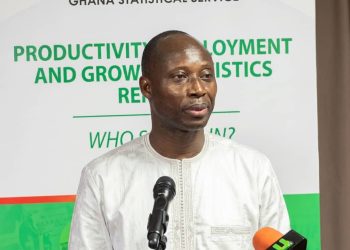
The Trades Union Congress (TUC) has called for the establishment of a tripartite national productivity council to monitor productivity trends and ensure workers benefit fairly from improvements in economic output.
The demand follows the launch of Ghana’s updated Productivity, Employment and Growth Statistics Report, which found that workers were producing significantly more value than three decades ago, but earnings had not kept pace with productivity gains in recent years.
Speaking at the launch, TUC representative Richard Acheampong said the report provided evidence to support longstanding concerns raised by organised labour during wage negotiations.
“For years, we went to the bargaining table and said workers are more productive but poorer. We are told to bring the evidence. Thankfully, the Ghana Statistical Service, with the support of the ILO and development partners, has given us this evidence,” he said.
He urged stakeholders to ensure the report influenced collective bargaining agreements, national budgets and Cabinet decisions rather than remain a reference document.
The TUC proposed a national productivity council involving government, employers and workers, with equal representation, to monitor productivity annually.
It also called for decent work and productivity targets to be incorporated into the national economic dialogue and the implementation plan for the 24-hour economy, including measures covering wages, working hours, occupational health and safety, particularly for informal sector workers.
The report found that the average worker produced GH¢15,197 worth of value in 2025 but earned approximately GH¢9,388, illustrating the difference between output generated and earnings received.
Government Statistician Dr Alhassan Iddrisu cautioned against interpreting the difference as entirely attributable to workers’ compensation, explaining that output also covers business costs, equipment, taxes and other expenses.
However, he said the widening gap between productivity and earnings over time was an important concern that required attention.
Acheampong said productivity improvements must be accompanied by fair compensation, training, workplace protection and workers’ participation in decision-making.
“Productivity without fair pay is exploitation. And growth without shared prosperity is not development,” he said.
He added that workers needed to be properly trained, protected at work and given a voice in negotiations to ensure productivity gains translated into better livelihoods.
The Ghana Statistical Service report also showed that earnings had recovered to GH¢9,388 in 2025 after falling to GH¢8,657 in 2021, but remained below the 2019 level of GH¢11,653.
The TUC said the findings should form the basis for stronger engagement among government, employers and organised labour on wage determination and the quality of employment.