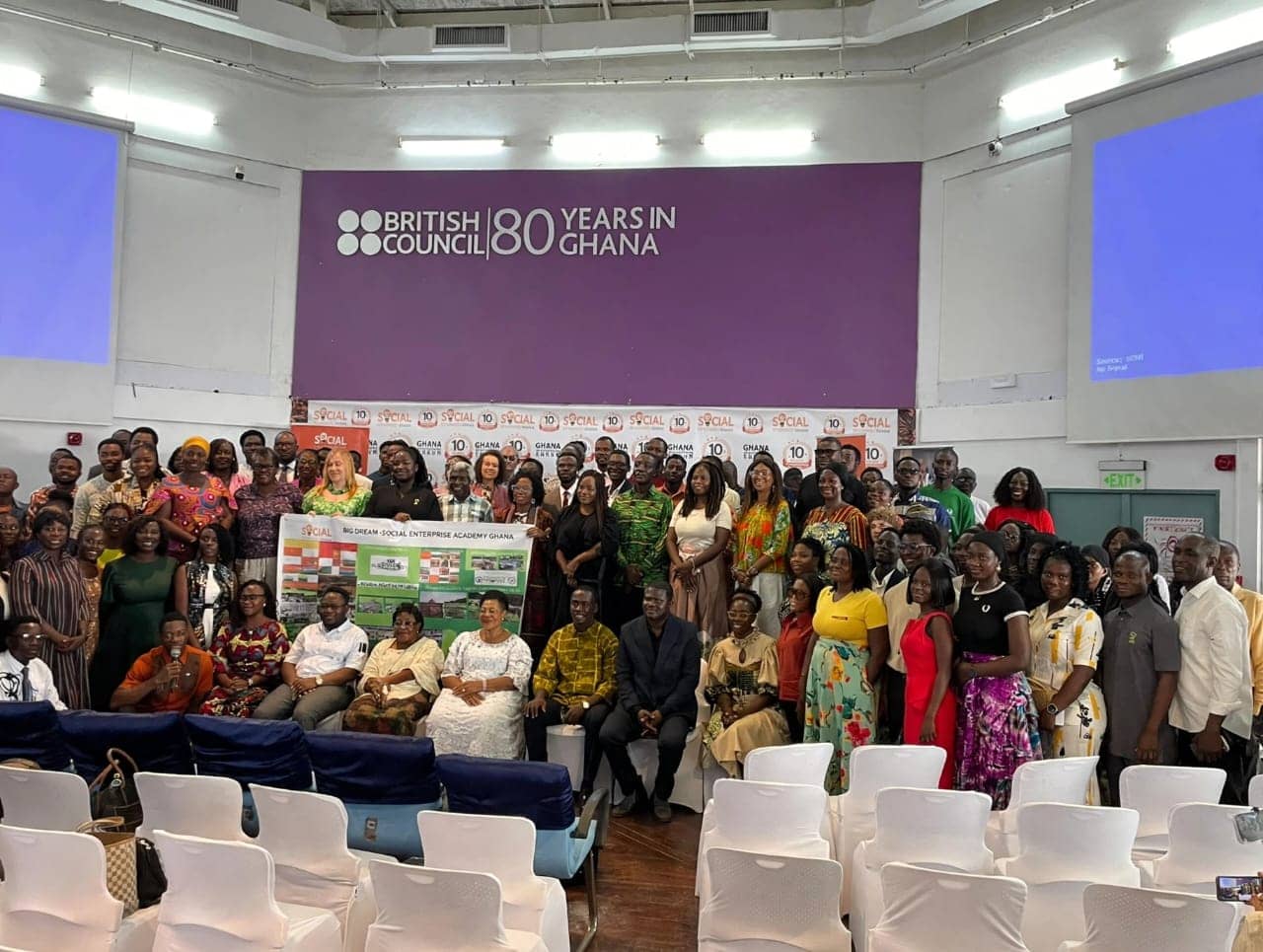
Social Enterprise Ghana (SE Ghana) has commemorated a decade of impact-driven entrepreneurship at the Ghana Social Enterprise Forum 2026, held at the British Council in Accra on November 19, 2026.
Convened under the theme “Celebrating a Decade of Impact: Building a Generational Legacy for Shared Prosperity,” the milestone forum brought together entrepreneurs, policymakers, investors and development partners to explore ways of identifying problems, developing solutions and creating lasting impact.
Delivering the welcome address, SE Ghana Board Chair Amma Lartey highlighted the network’s growth from about 200 founding members to more than 1,500 members across Ghana. She noted that collaboration had driven initiatives in green ventures, technical and vocational skills, social enterprise training, and projects developed with organisations representing persons with disabilities.

“Now, 10 years down the line, it’s alive and kicking and looking forward to having impact in the thousands and in the millions,” she said.
Guest speaker Rev. Albert Ocran addressed the sub-theme of shared prosperity, examining what enables organisations to endure beyond their founders and immediate challenges.
Drawing on McKinsey’s 7-S framework – strategy, style, staff, skills, systems, structure and shared values – he emphasised the importance of trust, opportunity creation and resilient systems in building lasting institutions.

“If we will make the impact that we desire, we must move beyond survival, move beyond our founding leaders, and also move beyond today,” he said.
Rev. Ocran also urged organisations to involve young people directly in initiatives designed to benefit them.
“If something is being done for young people, it must be done with young people and by young people. So I’m challenging us to make a shift and begin to get young people in, and they will impress you. They will surprise you,” he said.
“When we build enduring institutions, individuals benefit, communities benefit, and the nation benefits,” he added.
Development and academic partners, including Skills Initiative for Africa (SIFA), an AUDA-NEPAD initiative, reaffirmed their support for empowering young people, particularly young women, refugees and persons with disabilities, through their partnership with SE Ghana.

The partnership includes Funding Window 3 initiatives focused on green and digital skills for jobs and enterprise creation, as well as collaboration with the Commission for Technical and Vocational Education and Training (CTVET) to align training with national standards.
Representatives from Accra Technical University and the European Union Changemakers Project, alongside other partners, also congratulated SE Ghana on its 10th anniversary and reaffirmed their support for practical and inclusive enterprise development.
The forum also marked the launch of the Social Enterprise Academy. Through panel discussions, an exhibition featuring about 50 social businesses and networking sessions, participants explored enabling policies, impact financing, inclusion of entrepreneurs with disabilities and women-led ventures, and vocational and entrepreneurial education.
The academy is expected to strengthen structured training, mentorship and entrepreneurial capacity-building for young founders.