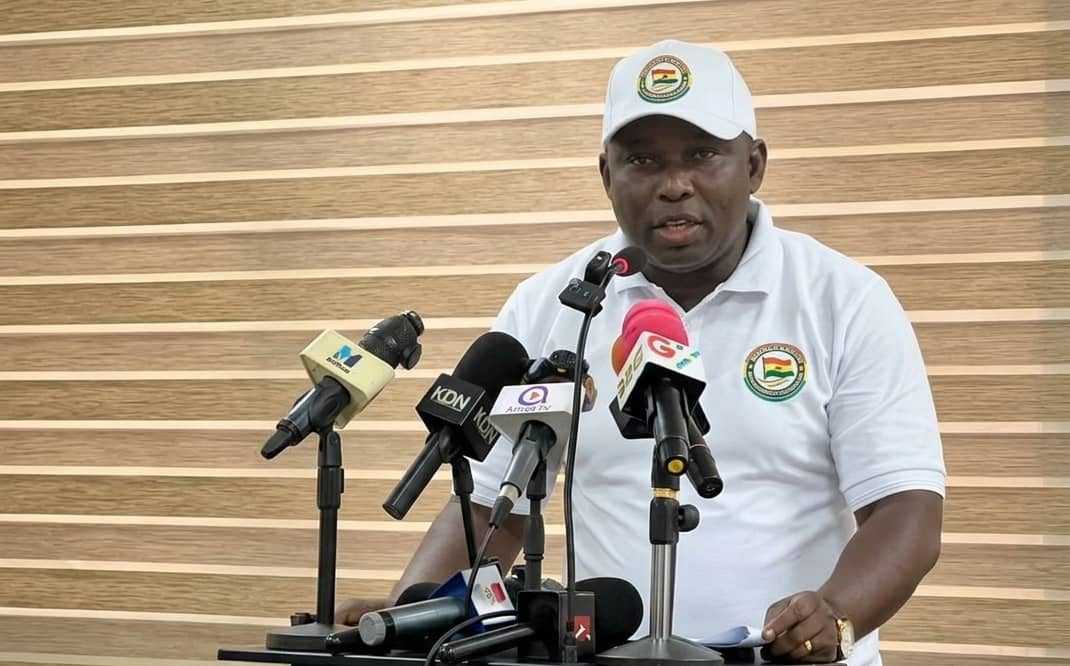
Co-founder of Democracy in Progress, Solomon Owusu, has called for accountability to become a permanent feature of Ghana’s democratic culture, arguing that citizens must be able to continuously question how public resources are managed.
Speaking at an Oral Accountability Demonstration in Accra on Friday, October 2, 2026, Mr Owusu said democracy should extend beyond elections and include responsible leadership, prudent management of public resources and adherence to the rule of law.
“Democracy must be about the people. Democracy must be about responsible leadership. Democracy must be about the prudent management of the resources entrusted to those who govern. And above all, democracy must be about accountability,” he said.
Mr Owusu linked accountability directly to Ghana’s economic and development challenges, saying the country had paid a high price for poverty, corruption and underdevelopment.
He cited inadequate infrastructure, limited opportunities for young people, unemployment and migration as some of the consequences of the country’s development challenges.
According to him, Ghana’s natural resources alone cannot guarantee prosperity without strong institutions, responsible leadership and proper management of public resources.
“Accountability is an economic issue. Accountability is a development issue. Accountability is a poverty issue. Accountability is a generational issue,” he said.
He further argued that when public resources are lost through corruption, waste, abuse or criminal conduct, the consequences are ultimately borne by ordinary citizens.
Mr Owusu said the call for accountability was grounded in the 1992 Constitution, citing its commitment to “Freedom, Justice, Probity and Accountability” and the rule of law.
He also referred to Article 1(1), which states that the sovereignty of Ghana resides in the people and that governmental powers are exercised in their name and for their welfare.
“Government does not own Ghana. Politicians do not own Ghana. Political parties do not own Ghana. Sovereignty belongs to the people,” he said.
He also cited Article 35(8), which directs the State to take steps to eradicate corrupt practices and abuse of power.
Mr Owusu said accountability should apply irrespective of political affiliation, arguing that allegations of wrongdoing should be investigated wherever they arise.
Mr Owusu specifically referred to former Finance Minister Ken Ofori-Atta, who he said had been declared a fugitive from justice by the Office of the Special Prosecutor.
He said Mr Ofori-Atta, like every citizen, should be presumed innocent until proven guilty, but argued that any issues concerning his alleged wrongdoing should be addressed through Ghana’s legal and judicial processes.
“Mr Ofori-Atta, like every citizen, is presumed innocent until proven guilty. But the place to establish that innocence is before the courts of the Republic he served, not from abroad,” he said.
The Democracy in Progress co-founder also called for the institutionalisation of Operation Recover All Loot (ORAL), saying it should not become a short-lived political initiative.
“ORAL must not be allowed to die a premature death,” he said.
“ORAL must become a culture. Not a spectacle. Not a political weapon. Not a partisan instrument. But a democratic culture of asking questions, demanding answers and insisting on accountability,” he added.
He stressed that accountability should continue between elections, noting that citizens should be able to question stalled projects, public contracts and government expenditure.
Calls for recovery of public funds
Mr Owusu urged the government and relevant state institutions to pursue the recovery of public funds where unlawful dissipation had been established.
He said assets acquired through unlawful conduct should be recovered through appropriate legal processes and institutional weaknesses that allow public resources to be abused should be addressed.
He cited Article 41(f) of the Constitution, which places a duty on citizens to protect public property and expose and combat the misuse or waste of public funds and property.
“Speaking up against the misuse of public resources is therefore not hostility towards any government; it is a constitutional duty,” he said.
He also called on political parties and their supporters to respect public institutions and officers, particularly when investigations or prosecutions are underway.
“If anyone believes an invitation, an investigation or a prosecution is unlawful, the remedy lies in the courts, not in intimidation, not in mob action, and not in attacks on public officers,” he said.