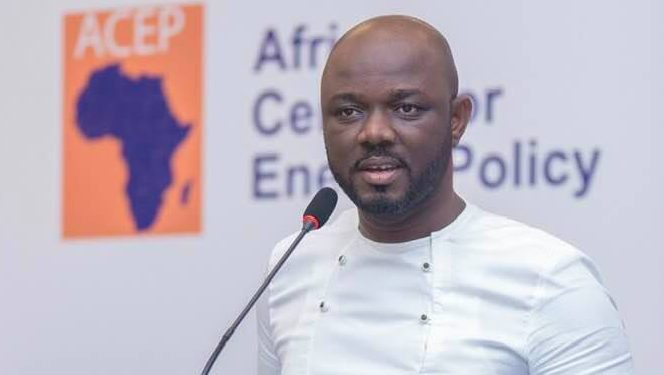
Africa Centre for Energy Policy (ACEP) Executive Director Benjamin Boakye has called for greater institutional discipline in Ghana’s handling of commercial disputes, following the country’s successful arbitration against Tullow Ghana Limited.
In a social media post on September 30, 2026, Mr Boakye congratulated the Ministry of Finance, Ghana Revenue Authority (GRA), Attorney-General’s Office and the legal team after an International Chamber of Commerce (ICC) tribunal dismissed Tullow’s claims and upheld the GRA’s US$393.09 million tax assessment.
He said the government’s response to the ruling was significant because it combined firmness on Ghana’s fiscal interests with a conciliatory approach towards Tullow, which he described as an important commercial partner.
“Losing an arbitration should not turn a commercial partner into an enemy of the State,” Mr Boakye said.
He noted that disagreements were inevitable in commercial relationships and argued that arbitration and the courts provided established mechanisms for resolving such disputes.
“Commercial relationships will inevitably produce disagreements. Where those disagreements cannot be resolved between the parties, independent mechanisms such as arbitration exist to determine them,” he said.
According to Mr Boakye, Ghana needed both the revenue generated from its petroleum sector and the investment and production that sustain those revenues.
He therefore welcomed the government’s recognition of Tullow’s continued importance to the Jubilee and TEN fields.
“Ghana needs its revenues, but it also needs the investment and production that generate those revenues,” he said.
Tullow has said it is disappointed with the tribunal’s decision but would engage the government on the implications and next steps. The company’s September 30 regulatory update said it would consider its options following further engagement with the government.
Boakye warns against criminalising commercial disputes
Mr Boakye said the arbitration should also prompt a broader discussion about how Ghana distinguishes commercial and civil disputes from criminal conduct.
“We need to better distinguish commercial and civil disputes from criminal conduct,” he said.
“A company challenging the State through arbitration is not, by that fact alone, an adversary of the State.”
He argued that businesses operating in Ghana did not have access to the coercive powers available to the State, making confidence in independent dispute-resolution mechanisms particularly important.
“Their protection is the confidence that the courts and agreed dispute resolution mechanisms will provide an independent and credible avenue for resolving disputes,” he said.
Mr Boakye cited the Power Distribution Services (PDS) case as an example of what he considered an institutional concern. He said what began as a commercial and contractual relationship between PDS and the Electricity Company of Ghana (ECG) was subsequently “criminalised by the State”, arguing that contractual remedies, reconciliation, arbitration or the courts could have been considered where appropriate.
He stressed, however, that criminal investigations and prosecutions remained necessary where there was evidence of criminal conduct.
“Of course, where there is evidence of criminal conduct, the appropriate institutions must investigate and prosecute,” he said. “But there must be a clear demonstration of what the criminal conduct is and how it arises, rather than allowing a contractual disagreement to become criminalised by default.”
Ghana’s arbitration ambitions
Mr Boakye also linked the Tullow case to Ghana’s wider ambition of becoming a credible seat for international commercial arbitration.
He argued that such credibility could not be achieved simply through a formal declaration but had to be developed through confidence in the country’s institutions.
“A seat of arbitration is not created by proclamation. It earns credibility over time through the confidence of businesses in the independence, predictability and integrity of its institutions,” he said.
He identified predictable courts, independent adjudication, respect for contractual processes and protection against the misuse of political or state power as important elements in building that confidence.
Mr Boakye disclosed that he had discussed some of these institutional issues with the Attorney-General and expressed hope that such engagements would contribute to reforms to strengthen Ghana’s commercial dispute-resolution and arbitration framework.
He also called for greater attention to the quality and durability of judicial decisions.
“Our judgments must be sufficiently rigorous, predictable and durable to withstand scrutiny, irrespective of where they are reviewed,” he said, adding that the issue was “not simply a judicial issue” but also one of investment and economic governance.
He further suggested that Ghana’s constitutional review process could consider how institutions could be strengthened to give commercial actors greater confidence that their rights and obligations would be fairly determined domestically.
Concluding his post, Mr Boakye said Ghana could eventually become a credible regional centre for international commercial arbitration, but stressed that such credibility would have to be earned through institutional practice.
“Winning an arbitration should not be treated as winning a war against a company,” he said. “It is simply the conclusion of a process through which the parties agreed to resolve a disagreement.”
The ICC tribunal’s September 29 award upheld the GRA’s US$393,091,993.70 assessment relating to Tullow’s taxation of business interruption insurance proceeds and found that the assessment did not breach the applicable petroleum agreements.
It also upheld the penalty and ruled that the assessment was not time-barred and that the GRA’s enforcement action was lawful.