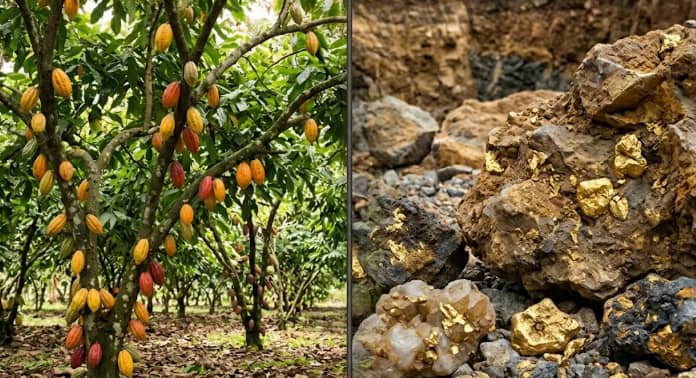
Businesses in Ghana’s gold, cocoa, manganese, bauxite and other sectors face new local processing deadlines under the government’s US$10 billion New Economy programme, which is expected to run from 2027 to 2030.
The programme, outlined in the 2027 Budget, seeks to expand domestic production, strengthen value addition, reduce import dependence and create jobs, with specific targets for local processing of commodities and the production of essential goods.
Under the plan, 70% of artisanal and small-scale gold is expected to be refined locally in 2027, rising to 100% in 2028, when exports of raw gold from the segment are to be prohibited.
The government is also targeting local processing of at least 50% of cocoa, manganese and bauxite by 2028, with the proportion expected to reach 100% by 2030.
Commercial rice imports are expected to be prohibited by 2030, while domestic producers are expected to supply between 60% and 80% of essential medicines by the same year.
The programme is built around eight pillars, including commercial agriculture, energy infrastructure, critical minerals value addition, tourism, textiles, pharmaceuticals, technology and affordable financing.
Commercial agriculture is expected to attract about US$3 billion, energy infrastructure US$2 billion, and critical minerals value addition US$1.5 billion. Tourism, textiles and pharmaceuticals are each earmarked for US$1 billion, while technology is allocated US$300 million.
The 2027 Budget allocates GH¢30 billion towards the programme, which the government estimates represents about 1.5% of gross domestic product (GDP).
The initiative is expected to support the government’s target of achieving 8% GDP growth by 2030 and reducing unemployment from 12.8% to below 8%.
However, Big Four accounting firm EY, in its analysis of the Budget, has raised concerns about gaps in the implementation framework, particularly the absence of timelines for some business-facing measures and clarity on financing for certain pillars.
The firm identified 11 measures affecting businesses, but only seven have implementation dates. These include public procurement preferences for Ghana-grown food, locally manufactured textiles and locally produced medicines where available, as well as sugar import permits and quotas, for which timelines have not been specified.
EY said the absence of clear dates could make it difficult for businesses to plan investments and prepare for regulatory changes.
It also noted that the Budget did not quantify existing gold refining capacity or the investment required to achieve the local processing targets ahead of the planned restrictions on raw exports.
Questions were also raised about the financing of the textiles and technology pillars and the breakdown of funding for the programme beyond 2027.
Meanwhile, some infrastructure projects are expected to advance, including a 1,450MW thermal power plant, with construction scheduled to begin in December 2026 and the first 600MW expected by 2028.
About US$3 billion has also been earmarked for the Accra–Kumasi Expressway, with tendering expected to conclude by the end of 2026.
EY has advised businesses to begin preparing for local processing requirements, reconcile customs and VAT records, and exercise caution in relying on announced incentives until the eligibility criteria are formally published.