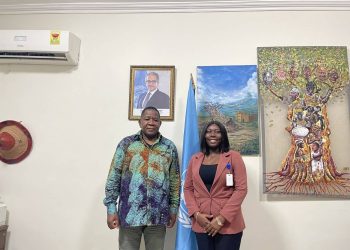
The Chief Executive Officer of the Ghana Free Zones Authority, Mary Awusi, has come under intense public criticism following remarks she made about the Chairman of the Church of Pentecost, Apostle Eric Nyamekye, in relation to the ongoing illegal mining (galamsey) crisis.
The controversy stems from comments made by Apostle Nyamekye during a church council meeting on Wednesday, where he raised concerns about the worsening pollution of Ghana’s water bodies due to galamsey activities.
He indicated that the situation had become so dire that the Church of Pentecost was considering alternative means for water baptism, as many natural water sources were no longer safe for use.
According to him, the church could not risk the health and safety of its members by continuing to use contaminated water bodies for religious rites.
However, reacting to the clergyman’s position during a political talk show on Class FM on Thursday, Mary Awusi launched a strong critique of the respected religious leader.
“Apostle Nyamekye is not as anointed as he thinks he is. If he were, he wouldn’t have said what he said. If he ever speaks this gibberish again, we will deal with him,” she said.
Her comments have since sparked widespread backlash across the political and social spectrum, with members of both major political parties and sections of the public condemning what they describe as an unprovoked and inappropriate attack on a prominent religious figure.
Critics argue that the CEO’s remarks undermine the important role religious leaders play in shaping national discourse, particularly on critical issues such as environmental degradation and public health.
Amid the growing controversy, the Ghana Pentecostal and Charismatic Council (GPCC) has weighed in, urging Christian leaders to remain steadfast in their responsibility to speak truth to power.
In a statement, the Council emphasized that Ghana is at a defining moment in its development, requiring courage, integrity, and a renewed commitment to truth from all stakeholders, especially religious leaders.
“Ghana stands at a defining moment in its development journey—one that requires courage, integrity, and a renewed commitment to truth. In this critical time, Christian leaders have a sacred responsibility to rise above partisan interests and speak for the good of the nation,” the GPCC stated.
The Council stressed that the mandate of Christian leadership is not rooted in political alignment but in moral clarity and national transformation.
“Our mandate is not political alignment, but moral clarity; not party loyalty, but national transformation,” the statement added.
Describing religious leaders as the conscience of society, the GPCC noted that their duty includes standing for truth regardless of the consequences.
“The example of Christ reminds us that speaking truth is not always comfortable—it attracts resistance, criticism, and sometimes persecution. Yet, just as Christ remained steadfast in His mission, so must we remain resolute in ours,” the Council said.