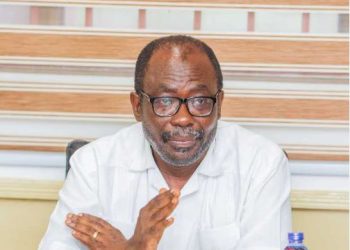
Chief Executive Officer of the Ghana Gold Board (GoldBod), Sammy Gyamfi, has rejected claims that fees paid to the institution contributed materially to the $1.7 billion loss recorded by the Bank of Ghana (BoG) under the Domestic Gold Purchase Programme in 2025.
Speaking at a press briefing in Accra on Wednesday, August 19, 2026, under the Government Accountability Series, Mr Gyamfi said the assay and service fees paid to GoldBod amounted to less than one percent of the 17 percent loss referenced in the IMF report.
He said GoldBod received an assay fee of 0.258 percent and a service fee of 0.5 percent, describing both as legitimate charges for services provided under the programme.
“The fees in question are not free money. As the name suggests, they are the standard fees charged to cover the cost of services rendered,” he said.
According to Mr Gyamfi, the assay fee was approved by Parliament under the Fees and Charges Act and covered assaying services, while the service fee was provided for under the September 2023 Gold Purchase Agreement.
He said the service fee covered costs associated with transportation, logistics, security, insurance and smelting losses.
Mr Gyamfi said the same service fee had been paid to PMMC and other aggregators involved in the Bank of Ghana’s gold purchase programme between 2022 and 2025.
He therefore disputed any suggestion that GoldBod’s fees could account for the scale of the losses reported by the IMF.
GoldBod rejects responsibility for BoG losses
The GoldBod CEO also took issue with attempts to attribute the Bank of Ghana’s losses to GoldBod, arguing that the two institutions are separate legal entities.
“Where in the world is one body corporate blamed for accounting losses incurred by another independent, separate and distinct body corporate without any evidentiary basis?” he asked.
He said GoldBod acted as a buying agent under the programme and did not determine the prices at which the gold was eventually sold.
According to him, GoldBod purchased and aggregated gold on agreed terms but had no role in determining selling prices or negotiating and signing off-take agreements.
Mr Gyamfi argued that because profit or loss in commodity trading is determined by the difference between selling price and cost, an entity that had no control over the selling price could not reasonably be held responsible for losses arising from the eventual sale.
He also cited the 2024 experience under the programme, when the Bank of Ghana recorded a $400 million loss even though GoldBod had not yet been established.
In 2024, he said, the PMMC and private company Resafire acted as buying and aggregation agents.
“If we are to accept this argument that losses under the Domestic Gold Purchase Programme are attributable to buying agents, then is Afenyo-Markin saying that buying agents in 2024 caused the loss of $400 million?” he asked.