President John Dramani Mahama has urged the international community to confront the historical legacy of the transatlantic slave trade and racialised chattel enslavement of Africans, arguing that the consequences of slavery continue to influence global inequalities.
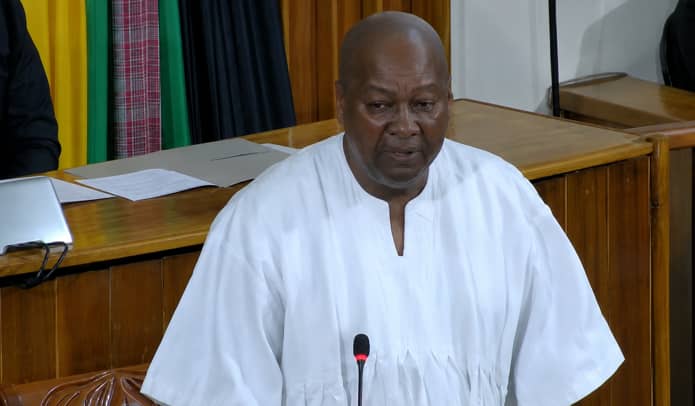
Addressing the Jamaican Parliament on Tuesday, August 4, during his State Visit to the Caribbean nation, President Mahama said acknowledging the history of slavery was essential to building a more just and equitable global order.
“As we honour our shared past, we must also confront it with honesty and fairness. History cannot be changed, but it can be acknowledged. And only by acknowledging it can we build a future that is founded on inspiration, justice and respect,” he said.
President Mahama described the transatlantic slave trade and racialised chattel enslavement as among humanity’s gravest historical crimes, stressing that their impact did not end with abolition.
“As was recently announced by the United Nations, the Transatlantic slave trade and the racialised chattel enslavement of Africans was the gravest crime committed to humanity. The consequences of this grave crime did not end when it was abolished. The consequences continue to shape the patterns of inequality and the conditions that have motivated our children and our wealth,” he said.
Push for reparatory justice
The President said the continuing consequences of slavery made the pursuit of reparatory justice necessary, calling for greater accountability and recognition of historical wrongs.
“For this reason, we must make steadfast advances in the cause. They should be inspired by our commitment to accountability, recognition of our rights, the recognition of historical wrongs, acknowledgement of the enduring consequences, and a collective determination to build a more just and equitable global order.”
President Mahama also expressed Ghana’s appreciation to Jamaica for supporting its reparatory justice initiative at the United Nations and for contributing to the Accra Next Steps Conference on Reparatory Justice.
He said the partnership between Ghana and Jamaica was helping to ensure that the descendants of enslaved Africans had a voice in shaping the global response to the historical injustices they inherited.
“Together, our two nations are ensuring that the descendants of those who suffered history’s greatest injustices are neither forgotten nor denied a voice in shaping a fairer world.”
Beyond a history of suffering
President Mahama also sought to broaden the narrative surrounding people of African descent, saying their history should not be defined exclusively by slavery and oppression.
“The story of people of African descent is not simply one of suffering. It is a story of resilience, excellence and enduring achievement. It is a story of civilisations that advanced humanity, of people who fought tirelessly for justice, of innovators who expanded the frontiers of science and technology, of artists whose creativity enriched global culture, and of statesmen and women who inspired nations to believe in the possibilities of freedom and self-determination.”
He said the ultimate objective of the reparatory justice campaign was to create a future in which historical truth, human dignity and justice were recognised as foundations for global progress.
“Our advocacy is ultimately about hope. Hope that our future generations will inherit a world in which historical truth is acknowledged, human dignity is upheld, and justice becomes the foundation for a lasting and free civilisation. That is the vision that continues to unite us. It is a vision to which we remain unwaveringly committed.”