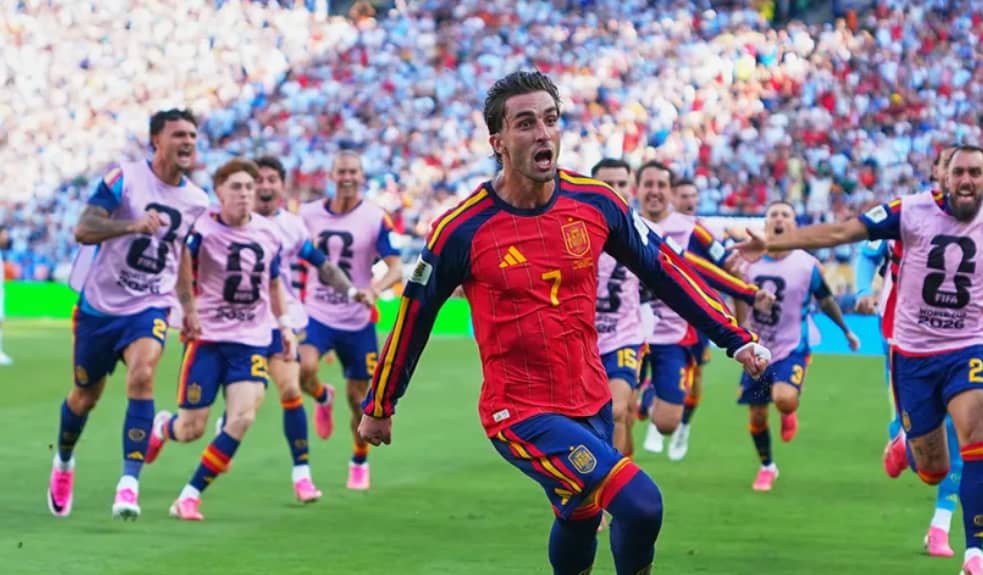
Spain dominated Argentina, but it took an extra-time goal to capture the World Cup for the first time since 2010.
The Spanish team defeated Argentina 1-0 in a grueling match that remained deadlocked at 0-0 for most of the game. The winning goal was scored by Spain forward Ferran Torres in the 106th minute of extra time.
Spain was favored to win, given its strong performance throughout the tournament, explained Brennann Klein, director of Northeastern University’s NetSI Sport research group. Spain never trailed in any match, conceded only one goal throughout the tournament, and consistently had the upper hand over its opponents through strong defending and dominance of possession.
It was that dominance and superior possession that led to Spain’s victory on Sunday, Klein said.
Passing network diagrams comparing Argentina’s and Spain’s starting XIs in the 2026 World Cup final showed player positions, pass volume, and involvement for each team. The networks, based on data through the semifinals, were provided by NetSI Sport.
Spain registered 20 shots compared with Argentina’s two.
“Spain played so well, they looked impenetrable. It seemed like it was always a question of ‘when,’ not ‘if,’ they would score,” Klein said.
Argentina, by contrast, struggled to create opportunities. Its standout performer was goalkeeper Emiliano “Dibu” Martínez, who made 11 saves during the match — the most ever recorded in a World Cup final, according to Klein.
Spain’s World Cup triumph comes two years after winning the 2024 UEFA European Championship and three years after Spain’s women’s team lifted the FIFA Women’s World Cup trophy.
“To me, that’s really what a national commitment to soccer looks like,” Klein said.
Spain previously won the World Cup in 2010, defeating the Netherlands 1-0 in the final.
Source: Northeastern Global News