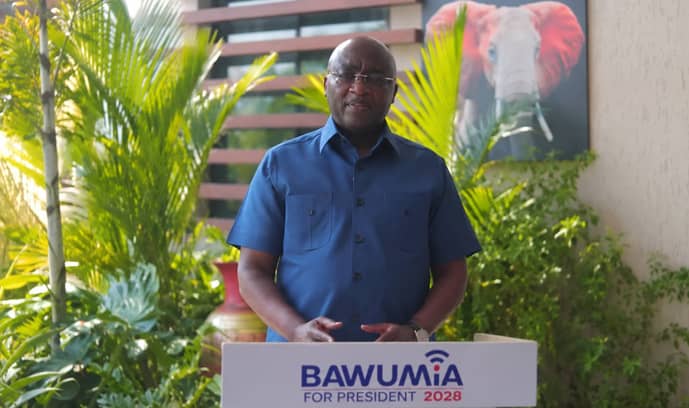
Former Vice President and New Patriotic Party presidential candidate, Dr. Mahamudu Bawumia, has appealed to President John Dramani Mahama not to assent to the recently passed Tribunals Bill, 2026, urging instead that the legislation be subjected to broad national consultation.
In a public address on Monday, Dr. Bawumia described the bill as one with far-reaching implications for Ghana’s justice delivery system, public confidence in the judiciary and the country’s democratic governance.
The appeal comes days after Parliament passed the Tribunals Bill, 2026, following the waiver of the mandatory one-day interval between the consideration stage and the third reading. The Minority’s objections were voted down, and the bill is expected to be transmitted to the President for assent.
“I have one respectful request of President Mahama. Mr. President, do not assent to this bill. Pause and let the nation ponder and deliberate on this very important matter,” Dr. Bawumia said.
He maintained that his appeal was not politically motivated, pointing to concerns previously raised by the Trades Union Congress (TUC), which had called for the withdrawal of the bill.
According to Dr. Bawumia, the TUC warned that the proposed legislation, in its current form, “could become a potent tool for weaponising justice delivery,” adding that those concerns reflected the views of organised labour rather than any political party.
The former Vice President also questioned the timing of the legislation, noting that the Constitution Review Committee established by President Mahama had reportedly recommended the removal of regional tribunals from the Constitution because their functions had largely been absorbed by the High Court.
He said the committee’s report, submitted last December, had not yet been made public.
“Before the nation has even read it, Parliament has rushed through and legislated in the opposite direction. Mr. President, publish the report first,” he said.
Dr. Bawumia further expressed concern that the bill would permit tribunal panels that include non-lawyers to adjudicate criminal matters, arguing that Ghana’s court congestion should instead be addressed by strengthening the existing judicial system.
“Our courts are congested, yes, but the answer to congested courts is to strengthen the courts, more judges, more courtrooms and digitised processes. It is not to build a second system of justice,” he stated.
While acknowledging the government’s large parliamentary majority, Dr. Bawumia urged restraint in the exercise of legislative power.
“Not everything that can be passed should be passed. The larger the majority, the greater the duty of restraint. History will not ask how many votes a law received. It will ask whether the law is just, equitable and seeks to promote and protect the interests of Ghanaians,” he said.
He proposed that the President withhold assent to the bill and instead initiate a national consultation involving the Ghana Bar Association, other legal professional bodies, organised labour, civil society organisations, political parties and the judiciary.
According to Dr. Bawumia, reforms to Ghana’s justice system should be founded on broad national consensus rather than parliamentary numbers alone.
“Justice belongs to no government and no party. It belongs to the Ghanaian people, and a law that reshapes the architecture of justice should rest on national consensus, not on headcount,” he said.
He further called on the President to use the Council of State, in accordance with Articles 90 and 106 of the 1992 Constitution, to facilitate a national dialogue before taking any decision on the bill.