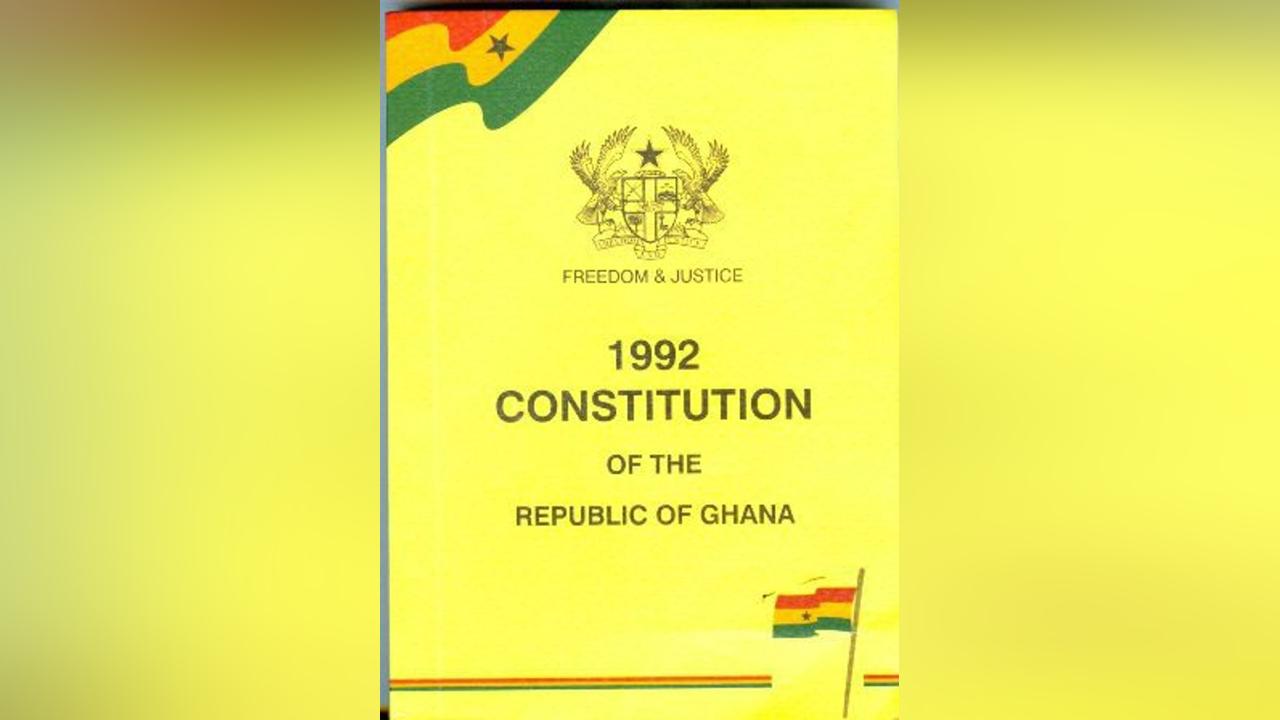
For more than three decades, Ghana’s 1992 Constitution has provided the framework for the country’s democratic experiment. It has survived changes of government, disputed elections, economic crises and evolving public expectations.
Now, the government wants to rewrite significant parts of that framework.
At the heart of the proposed changes is a question that goes beyond constitutional language: How should Ghana’s democracy work in the decades ahead?
The government has accepted a broad package of reforms emerging from the Constitutional Review Committee (CRC), including a five-year presidential term, greater political opportunities for dual citizens, elected District Chief Executives, expanded human rights protections and changes to the structure of the executive and judiciary.
Presenting the government’s position at Jubilee House in Accra, Attorney-General and Minister of Justice Dominic Ayine described the proposed reforms as an attempt to move Ghana from “electoral democracy to a developmental democracy”.
The scale of the exercise is substantial. The CRC submitted 206 proposals to President John Dramani Mahama in February — 147 amendments to existing constitutional provisions and 59 new provisions.
But the government’s position is not simply an endorsement of the committee’s recommendations. In several areas, it has modified or gone beyond them.
A presidency with more time
Perhaps the most consequential change would be the move from a four-year to a five-year presidential and parliamentary term.
The argument is familiar: governments often spend their first months managing transitions and their final year preparing for elections, leaving a narrower window for implementing long-term policies.
A five-year term, the government believes, would give administrations more room to plan and execute programmes before returning to voters.
The proposal would also lower the minimum age for presidential candidates from 40 to 35. The CRC had proposed 30.
The change reflects an attempt to balance two competing considerations — opening political leadership to a younger generation while maintaining an age threshold the government considers compatible with experience and maturity.
The electoral calendar would also be redesigned. Presidential elections would be held in the first week of November, allowing roughly two months before the January 7 inauguration.
For a country where election disputes can quickly become politically charged, the government has also accepted defined timelines for presidential petitions: 14 days to file and 30 days for the Supreme Court to determine them.
The Electoral Commission would be required to disclose relevant electoral data to the court and parties involved in a petition.
The dual citizenship question
Few proposals are likely to generate as much debate as the proposed removal of the parliamentary restriction on dual citizens.
Under the government’s position, Ghanaians by birth who have acquired citizenship elsewhere would be allowed to contest parliamentary elections.
The restriction would remain for the presidency and vice-presidency.
This means Multiple citizenship will no longer disqualify a person from holding specified offices, except that of President and Vice-President of the Republic.
The implications extend beyond Parliament.
If adopted, dual citizens could potentially occupy positions such as Chief Justice, Speaker of Parliament and Chairperson of the Electoral Commission — offices currently affected by constitutional restrictions.
The proposal reflects the changing relationship between Ghana and its diaspora, but it also raises questions about allegiance, public trust and the appropriate limits of political participation for citizens who hold another nationality.
Those questions will likely become part of the public debate as the reforms move forward.
A Parliament designed differently
The proposed reforms would place a ceiling of 300 members on Parliament.
Of these, 276 would continue to be elected directly from constituencies, while 24 would be chosen through a proportional representation system intended to increase the participation of women, young people and persons with disabilities.
The idea is to supplement constituency-based representation with a mechanism that could address groups that remain under-represented in Parliament.
How that system would work in practice, however, remains to be determined. The government plans to commission an independent study to develop the model.
The number of ministers would also be capped at 60, slightly above the CRC’s proposed 57.
More importantly, ministers would not necessarily have to be MPs, potentially widening the pool from which presidents can select members of the executive.
Redrawing the architecture of government
One of the less publicly discussed but potentially important reforms concerns the Attorney-General.
The government proposes separating the Attorney-General from the Ministry of Justice.
Under the proposed structure, the Attorney-General would no longer be a Cabinet minister. The office would, however, retain its role as the government’s principal legal adviser and repository of prosecutorial authority.
A separate Minister of Justice would oversee the justice sector.
The Attorney-General would have terms and conditions equivalent to those of a Supreme Court Justice and could only be removed through the constitutional procedure under Article 146.
The judiciary would also see changes. The government supports a single, non-renewable 10-year term for the Chief Justice, subject to the retirement age of 70.
The Supreme Court would have a maximum of 19 justices, compared with the CRC’s proposed 15.
From constitutional rights to enforceable protections
The reforms also reach into an area that directly affects everyday life: fundamental rights.
The government has accepted proposals to expand protections for women, children, persons with disabilities, older people and young people, alongside economic, social and cultural rights.
Healthcare, housing, food and a clean environment would receive greater recognition within the proposed framework.
But there is a constitutional complication. Many of the existing rights in Chapter Five are entrenched, meaning that changing them individually would require a national referendum.
The government’s proposed solution is a comprehensive Human Rights Act.
Rather than repeatedly reopening the Constitution, legislation would elaborate existing rights, introduce additional protections and incorporate Ghana’s obligations under international conventions.
The proposed law itself would receive special protection: any amendment or repeal would require the support of 75% of MPs.
The government has also accepted the abolition of the death penalty, replacing capital punishment with life imprisonment.
Bringing local government closer to voters
The proposed reform of District Chief Executives could alter the relationship between central government and local communities.
The government wants all DCEs to be elected, going further than the CRC’s recommendation for a phased approach based on the fiscal capacity of individual districts.
The proposed process would begin with five presidential nominees, including at least two women. Three would be shortlisted, with at least one woman, before voters make the final choice.
The proposal could strengthen local democratic accountability, but it would also change the traditional relationship between the President and DCEs, who currently play a key role in implementing central government policies at the district level.
Changing the rules around political parties
The reforms would also reach inside Ghana’s political parties.
The government supports a requirement that registered parties give all members in good standing equal voting rights when selecting presidential and parliamentary candidates.
This comes against the backdrop of growing debate over internal party democracy and the role of delegates in determining candidates.
The government also supports the creation of an independent Political Parties Regulatory Commission to oversee the registration and regulation of political parties.
Campaign financing and internal party democracy would be addressed through legislation.
On fiscal policy, however, the government has drawn a line. It rejected the proposal to embed fiscal sustainability rules in the Constitution, arguing that such rules need flexibility as economic conditions change.
Instead, the relevant provisions would be incorporated into the Public Financial Management Act.
A constitution that citizens can help change
One of the more ambitious proposals is the introduction of a citizen initiative mechanism for constitutional amendments.
Under the proposed system, citizens could initiate amendments after securing sufficient support from registered voters and meeting requirements for regional representation and gender balance.
The government has also accepted a heritage-based pathway to citizenship for persons of African descent in the diaspora, with Parliament expected to establish the criteria and safeguards.
Together, these proposals point to a broader ambition: making constitutional participation less dependent on political institutions alone.
The referendum test
The government’s position is now only one stage in what could be a lengthy process.
Two constitutional amendment bills are expected by October.
The first would deal with non-entrenched provisions under Article 291. The second would cover entrenched provisions under Article 290 and would require approval in a national referendum.
For an entrenched amendment referendum to succeed, at least 40% of eligible registered voters must participate, and at least 75% of those voting must support the proposal.
The government plans to hold that referendum alongside the 2027 district-level elections, partly to avoid the cost of organising a separate national vote.
That could make 2027 a defining moment for Ghana’s constitutional order.
The proposals still face parliamentary scrutiny, public debate and, in some cases, the ultimate judgment of voters. Some will attract broad support; others are likely to provoke intense discussion over political power, accountability and institutional independence.
What is clear is that this is not simply an exercise in updating constitutional language.
It is an attempt to reconsider how power is acquired, exercised and restrained in Ghana — and, ultimately, how much influence ordinary citizens should have over the institutions that govern them.
If the reforms survive Parliament and the referendum process, Ghana’s next constitutional chapter could look markedly different from the one that began in 1992.