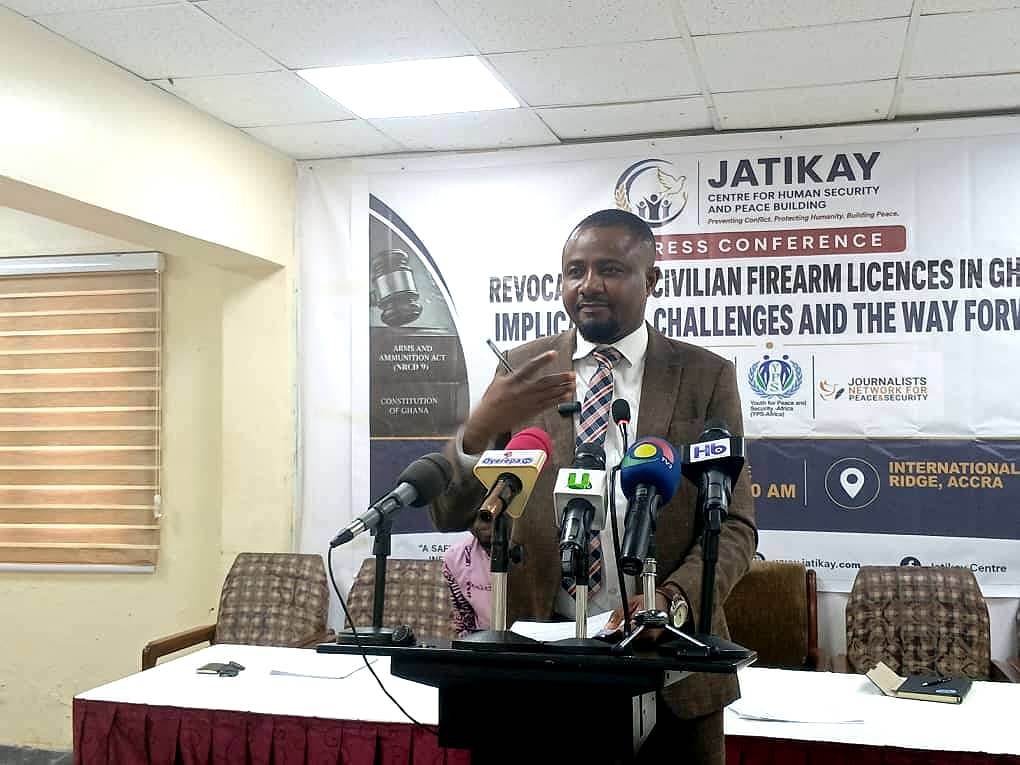
The Jatikay Centre for Human Security and Peace Building has called on the government to suspend the blanket implementation of its directive revoking civilian firearm licences, warning that the exercise could create confusion, overwhelm state institutions and erode public confidence if implemented without adequate planning.
Speaking on Monday at a press conference in Accra under the theme, “Revocation of Civilian Firearm Licences in Ghana: Implications, Challenges and the Way Forward,” Executive Director of the Centre, Adib Saani, said while the objective of strengthening firearm regulation was commendable, the current implementation approach was deeply flawed.
He questioned the operational framework for the exercise, asking how many licensed firearm holders would be affected, where mandatory practical firearm training would be conducted across the country, who would bear the associated costs, what documentation applicants would be required to provide, and how the process would accommodate persons who are ill, travelling, residing abroad or living in remote parts of the country.
Mr Saani also sought clarification on how the directive would affect private security personnel, traditional leaders, business owners and other individuals who lawfully acquired firearms for personal protection.
“It is not enough to say people should go for tests. Public administration is not an announcement. It involves planning, coordination, capacity, logistics, communication, documentation and most importantly accountability,” he said.
He argued that requiring thousands of firearm holders to report to limited facilities such as the Tesano Police Shooting Range, NACOC-approved drug testing centres and already overstretched mental health professionals could result in congestion, delays, unnecessary costs and opportunities for abuse.
Mr Saani further criticised what he described as inadequate public education surrounding the directive, saying firearm regulation affects public safety, lawful ownership, policing, community trust and national security and therefore cannot be implemented without extensive public sensitisation.
“The public must be educated on what has changed, why it has changed, what the legal basis is, what firearm owners must do, what timelines apply, what offences may arise and what safeguards exist against official treatment,” he said, adding that the National Commission on Small Arms and Light Weapons had a clear mandate to educate and sensitise the public on such matters.
The Executive Director also warned that the directive could undermine the trust built during the government’s recent gun amnesty programme, during which citizens were encouraged to surrender or regularise unregistered firearms without fear of arrest or prosecution.
According to him, more than 4,000 weapons were reportedly surrendered or regularised under that exercise, making it a significant success that should not be jeopardised.
“Amnesty programs work only when citizens trust the state. If people are encouraged to regularize their firearms today and shortly afterwards all licenses are suspended or revoked without a clear transitional arrangement, the message to the public becomes confusing. The next time the government declares an amnesty, why should people trust it?” he asked.
Mr Saani said Ghana’s response to firearm regulation should focus on comprehensive legislative reform rather than administrative directives, noting that a new Arms Bill had already been developed with input from civil society organisations and other stakeholders, including himself.
He explained that the proposed legislation seeks to modernise Ghana’s firearms control regime through clearer licensing procedures, stronger institutional coordination, improved national databases, better marking and tracing systems, certified shooting ranges and regulated public-private partnerships.
“The solution is not merely to revoke licenses. The real solution is to pass a modern law that provides the resources and that will also build the credibility of national firearms databases, trained enforcement officers, certified shooting ranges, and create a transparent and renewable system that is fair, firm, and predictable,” he said.
Mr Saani stressed that due process must remain central to any reform, noting that firearm licences are issued by the state through established administrative procedures and cannot simply be invalidated without legal clarity.
“We therefore call on the Ministry of the Interior to clarify whether this is a revocation, suspension, recall, audit, or re-registration exercise. We need to know. These have different legal meanings. Citizens must not be left confused,” he asserted.
He further urged the Ministry to publish the legal basis for the directive, implementation guidelines, categories of persons affected, applicable exemptions, timelines, approved testing centres, cost structure and appeal mechanisms for applicants whose licences may be refused or withdrawn.
Mr Saani called on authorities to distinguish between lawful firearm owners and criminals, stressing that while illegal weapons, arms trafficking and violent crime remain serious threats, licensed firearm holders should not automatically be treated as offenders.
“The state must target illegal possession, illicit manufacturing, arms trafficking, misuse of registered firearms, and irresponsible licensing. Lawful owners must be regulated firmly, but they must not be treated unfairly.”