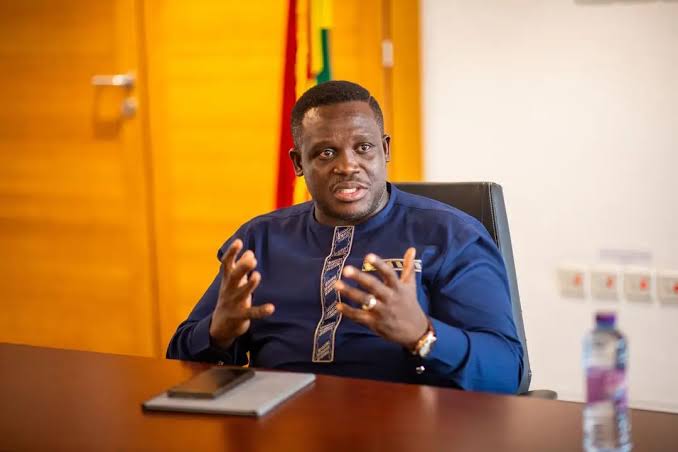
Communications, Digital Technology and Innovations Minister Samuel Nartey George says the government’s receipt of the Digital Terrestrial Television (DTT) Committee’s final report marks a significant step towards securing the long-term sustainability and governance of Ghana’s digital broadcasting platform.
Speaking at a ceremony to receive the committee’s report, the minister said the process demonstrated the value of dialogue between government and industry stakeholders in resolving longstanding challenges affecting the country’s digital television infrastructure.
“It demonstrates what can be achieved when government and industry stakeholders engage in open, transparent dialogue with mutual respect and a shared commitment to finding practical solutions to our national challenges,” he said.
Mr. George noted that while Ghana’s migration from analogue to digital television broadcasting fulfilled an international obligation and improved spectrum efficiency, expanded broadcasting services and created new opportunities for innovation, the long-term success of the platform depends on effective governance and sustainable financing.
According to him, over the years, stakeholders raised concerns over operational financing, infrastructure management, governance arrangements, institutional responsibilities and the overall viability of the DTT platform.
He explained that following a stakeholder meeting convened on February 24, 2026, the Ministry recognised that the issues extended beyond channel fees to broader questions about ownership, governance, service quality and sustainable financing.
This, he said, led to the establishment of the DTT Committee to undertake a comprehensive review and provide objective, practical and evidence-based recommendations to guide future government policy.
“The committee members were carefully selected to ensure ownership and one voice built on consensus for effective implementation,” he said.
Mr. George disclosed that although the committee had initially been expected to complete its work by the end of June, the Ministry approved an extension to allow for additional consultations, validation of technical and financial submissions, and broader stakeholder engagement.
He commended members of the committee and stakeholders across the broadcasting industry for trusting the process despite disagreements along the way.
“I’ve gotten complaints from every single one of them along the line. Everybody had a problem with the process, but we trusted the process, and here we are today,” he said.
The minister assured stakeholders that the Ministry would carefully study the report before taking implementation decisions and pledged to issue a white paper outlining government’s policy position.
“You can be rest assured, even before the Ministry takes concrete policy decisions, I’ll issue a white paper that will be shared with all members of the DTT committee for us to have consensus going forward,” he said, adding that the objective is to establish a governance framework that is transparent, equitable, financially sustainable and capable of supporting continued investment and innovation in the broadcasting sector.
He also announced that the Ministry’s position paper on the committee’s recommendations would be made available within 14 days.
Mr. George said the government remains committed to resolving challenges within the communications sector, describing the completion of the committee’s work as another fulfilled commitment.
“What took ten years to fix, you achieved in five months,” he told committee members.
Earlier, speakers at the event praised the Ministry for adopting a consultative approach to addressing challenges facing the DTT platform.
They described Ghana’s national digital terrestrial television infrastructure as a strategic national asset that strengthens the country’s information sovereignty by providing a reliable platform for broadcasting authentic and universally accessible information.
The speakers said the decision to establish a broad-based stakeholder committee and allow it to deliberate independently reflected government’s commitment to transparency, accountability and participatory governance.
They also urged broadcasters and media practitioners to continue upholding professionalism and responsible journalism amid the growing spread of misinformation and disinformation on digital platforms.
The committee recommended a public interest-based subsidised pricing model for the DTT platform, arguing that broadcasting serves an essential public function and that a sustainable cost-sharing framework is necessary to ensure the long-term viability of the infrastructure.
Following the formal presentation of the report, representatives of key stakeholder institutions, including the Ghana Independent Broadcasters Association (GIBA), the Ghana Broadcasting Corporation (GBC), the National Communications Authority (NCA), the National Media Commission (NMC) and K-NET, signed the final document before presenting it to the minister.
The Ministry is expected to review the report’s recommendations before adopting policy measures to strengthen the governance, financing and operations of Ghana’s Digital Terrestrial Television platform.