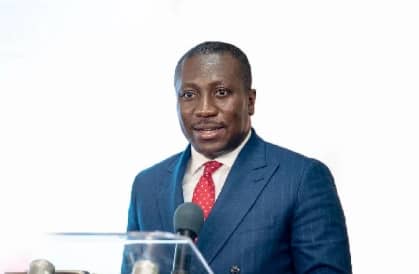
Minority Leader Alexander Afenyo-Markin has rejected attempts to dismiss reported GH¢22 billion losses associated with Ghana’s domestic gold purchasing programme on the grounds that the losses were recorded in the Bank of Ghana’s (BoG) accounts rather than the financial statements of the Ghana Gold Board (GoldBod).
Addressing a press conference in Parliament on Tuesday, August 18, Mr Afenyo-Markin said the location of a loss in an institution’s accounts did not change the underlying economic reality of the transaction.
“The accounting location of a loss does not change its economic reality,” he said, insisting that the focus should be on who designed the arrangement, executed the transactions, controlled the risks and ultimately bore the financial consequences.
The Minority Leader acknowledged that GoldBod could argue that it acted as an agent of the Bank of Ghana in purchasing gold. However, he said such an arrangement could not be used to completely distance GoldBod from the operational consequences of the transactions.
“Gold Board cannot hide behind accounting technicalities,” Mr Afenyo-Markin said. “Gold Board is entitled to make the accounting point that it was purchasing gold on behalf of the Bank of Ghana. But agency does not extinguish operational responsibility.”
He noted that GoldBod played a central role in buying, aggregating, assaying, valuing and exporting gold, while BoG provided the financing and absorbed the reported trading losses.
Mr Afenyo-Markin therefore questioned the basis for celebrating GoldBod’s reported surplus without taking into account costs allegedly borne by BoG.
“We therefore reject any attempt to answer the public concerns merely by pointing to GoldBod’s reported surplus,” he said.
According to him, GoldBod’s profitability and the profitability of the transactions it executed for BoG were two different matters.
“A middleman can earn a fee while the principal loses money,” he argued.
He said the arrangement therefore required scrutiny of GoldBod’s pricing decisions, fees, discounts, off-taker selection and risk controls.
The Minority Leader maintained that the reported losses could not simply be ignored because they appeared on BoG’s balance sheet, arguing that public accountability must extend beyond the technical presentation of financial statements.
He said the central question was whether Ghana received adequate value for the risks assumed through the programme.