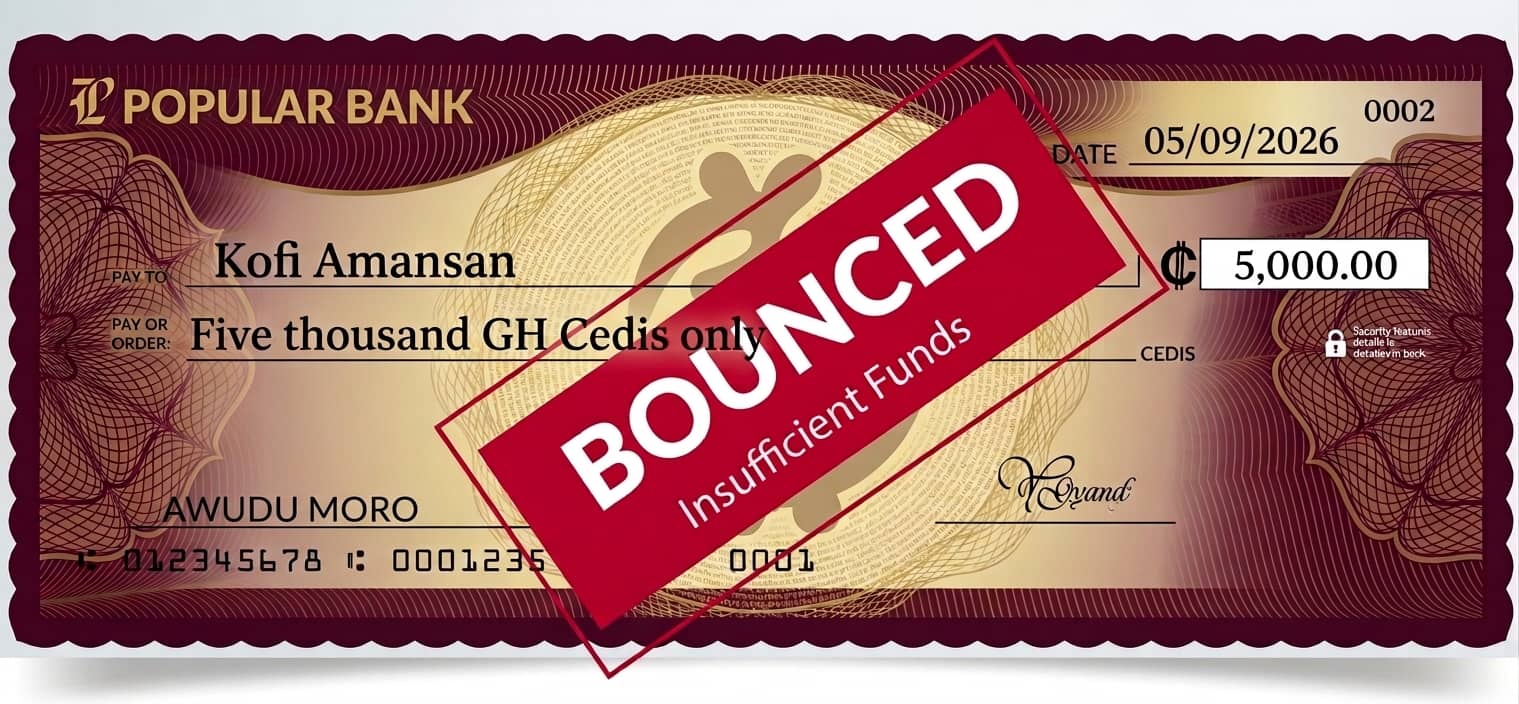
The Bank of Ghana has introduced revised sanctions for individuals and businesses that issue cheques without sufficient funds in their accounts.
The measures, contained in the Bank of Ghana’s Revised Dud Cheques Notice – 2026, provide for escalating financial penalties, reporting to Credit Reference Bureaus (CRBs), restrictions on cheque issuance and, in certain circumstances, bans on operating current accounts.
A dud cheque is defined under the revised rules as a cheque drawn on an account with insufficient available funds to cover the amount stated on the cheque.
Under the new framework, sanctions will escalate based on the number of offences committed within a rolling 12-month period.
For a first offence, the issuer will be liable to a penalty equivalent to 10% of the face value of the cheque and will receive a warning notification outlining the consequences of further violations. The incident will also be reported to the CRBs and the Bank of Ghana.
A second offence within 12 months attracts a penalty of 15% of the cheque’s face value, together with another warning and reporting to the CRBs and the central bank.
For a third offence within the same 12-month period, the penalty rises to 20% of the cheque’s face value. The issuer will also be reported to the CRBs and the Bank of Ghana, banned from issuing cheques for at least three years, and restricted from accessing new credit facilities for one year.
Following a third offence, the Bank of Ghana will notify commercial banks and Specialised Deposit-Taking Institutions (SDIs) of the ban. The affected bank must, within five working days of receiving the notification, inform the customer, recall all unused cheque books and stop issuing new cheque books until the sanction is lifted.
The revised rules also provide additional measures for customers who fail to surrender unused cheque books within 10 working days after notification of a ban. Such cases may be reported to the Bank of Ghana, which may impose a ban on operating any current account and include the individual or entity in its Directory of High-Risk Cheque Issuers.
The BoG said reporting dud cheque offences to Credit Reference Bureaus could affect an issuer’s credit profile and potentially result in higher borrowing costs or reduced access to credit.
The central bank has urged account holders to verify their available balances before issuing cheques and take into account pending transactions, uncleared payments and other charges that could reduce available funds.
It has also advised customers not to issue cheques based solely on expected future inflows and to keep records of issued cheques and their expected presentation dates.