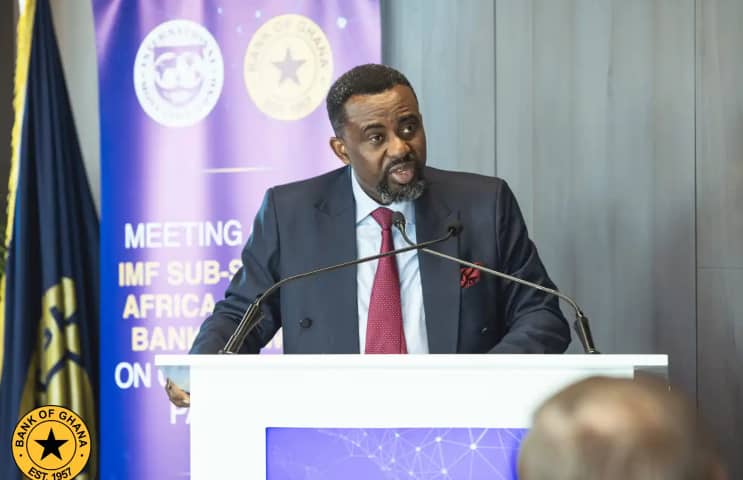
The Bank of Ghana (BoG) has outlined a series of reforms to modernise its monetary policy framework, with Governor Dr Johnson Pandit Asiama stressing the need for policies that are more transparent, data-driven and responsive to emerging economic pressures.
Speaking at a High-Level Forum on the Modernisation of Monetary Policy Formulation and Implementation in Accra on Monday, August 17, 2026, Dr Asiama said the reforms were intended to strengthen the effectiveness and credibility of monetary policy amid growing global economic uncertainty.
He said central banks were increasingly confronted with overlapping shocks, including geopolitical tensions, volatile commodity and energy prices, changing global trade and financial patterns, rapid technological advancement and increasingly complex financial systems.
“A disruption in one part of the world can quickly translate into higher food and energy prices, exchange-rate pressures, tighter financial conditions, and renewed inflationary pressures in economies thousands of miles away,” he said.
According to the Governor, monetary policy modernisation must therefore go beyond developing better economic models or introducing additional policy instruments.
“It is about reducing the distance between the policy we intend, the policy the market understands, and the policy the economy ultimately experiences,” he said.
MPC decision-making shifts to majority voting
A major reform introduced by the BoG is the transition from a consensus-building approach to a majority-vote system for Monetary Policy Committee (MPC) decisions.
Dr Asiama said the change, implemented since March 2025, brings the Bank’s practices closer to those of other major inflation-targeting central banks.
The Bank now publishes individual decision statements from MPC members, setting out the data-driven reasoning behind their preferred policy direction.
The Governor said the approach was designed to improve transparency and accountability in monetary policy decisions.
“Credibility does not require uniformity of views within a Monetary Policy Committee. It requires judgments to be grounded in evidence, the collective decision to be clear, and the institution to be accountable,” he said.
He said the reform moved the decision-making process away from “behind closed doors” deliberations towards a more transparent and data-driven system.
New tools to improve policy transmission
The BoG has also recalibrated its monetary policy implementation framework, including the reintroduction of the 14-day bill as its main instrument for conducting open market operations.
Dr Asiama said the move was intended to improve market functioning and strengthen the transmission of monetary policy signals.
The Bank has also introduced a new Foreign Exchange Operations Framework, which provides a transparent and rules-based approach to foreign exchange interventions.
According to the Governor, the framework clarifies the objectives of interventions, supports reserve accumulation and helps reduce excessive exchange-rate volatility while maintaining a flexible, market-determined exchange rate.
Real-time data to strengthen inflation management
The BoG is also increasingly relying on technology and high-frequency data to identify emerging inflationary pressures.
Dr Asiama said the Bank’s e-inflation measure is computed almost in real time, providing more timely information on price developments and strengthening its now-casting and near-term inflation forecasts.
“The objective is clear: to ensure that our policy decisions are guided not by short-term pressures, speculation, or sentiments, but by evidence, a careful assessment of risks, and a forward-looking view of the medium-term outlook for price and financial stability,” he said.
The reforms also include amendments to the Bank of Ghana Act aimed at reinforcing central bank independence, formalising MPC mandates and decision-making processes, and strengthening limits on monetary financing of the national budget.
The Bank has further upgraded its Forecasting and Policy Analysis System and Quarterly Projection Model to incorporate sector-specific dynamics, construct baseline forecasts, test alternative scenarios and assess risks around the economic outlook.
Dr Asiama said the reforms had already contributed to positive outcomes, noting that inflation, which had been significantly elevated, had declined sharply and overshot the medium-term target.
He said the Bank’s experience demonstrated that monetary policy frameworks must be adapted to the circumstances of individual economies rather than simply copied from other jurisdictions.
“The value of peer learning is not to discover a framework to copy. It is to understand what works, why it works, and under what conditions it works,” he said.
The two-day forum, organised with the support of IMF AFRITAC West 2, brought together central bank officials and policymakers to exchange experiences on strengthening monetary policy formulation and implementation.