
Ghana’s proposed non-interest banking framework could expand financing opportunities for businesses and entrepreneurs through a profit-sharing arrangement that does not require borrowers to pay predetermined interest on loans, strategic modeller Michael Nyarko has said.
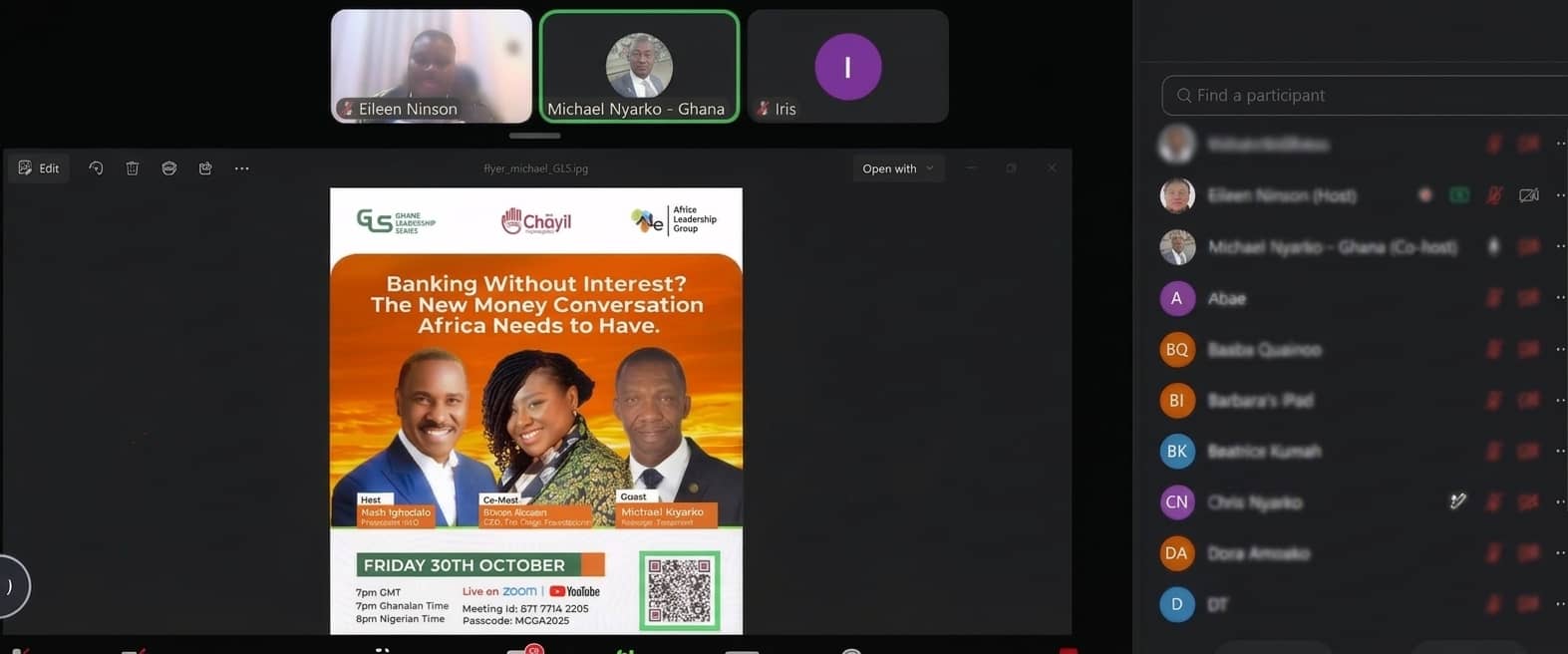
Speaking at a virtual leadership engagement organised by the Ghana Leadership Series, The Chayil Foundation and Africa Leadership Group (ALG) on Friday, October 30, Mr. Nyarko explained that the emerging banking model would provide an alternative to conventional lending by linking returns to the performance and profitability of financed businesses.
The discussion, held under the theme “Banking Without Interest? The New Money Conversation Africa Needs to Have”, was hosted by Eileen Ninson, Chief Executive Officer of The Chayil Foundation.
Mr. Nyarko said the fundamental difference between conventional banking and non-interest banking was how financial returns were determined and shared between financiers and businesses.
Under conventional banking, he explained, banks assess prevailing economic conditions, inflation, monetary policy rates and business risks before determining the interest charged on loans.
However, under the non-interest model, the financier provides capital for an agreed business activity and shares in the profits generated according to a predetermined ratio.
“If you take that money, I am not going to predetermine the interest that I would take. But I am interested in the profit you are going to make. And then, at the end of every period, we will all sit down, look at the profit that has come in, and then we will share according to this ratio,” he said.
He illustrated the arrangement with a business receiving GH¢5,000 to execute a contract and generating GH¢500 in profit. The financier and entrepreneur could agree to share the returns in a ratio of two to three, with the financier receiving GH¢200 and the entrepreneur retaining GH¢300.
According to him, the arrangement could offer businesses some breathing space, particularly in sectors where revenue generation depends on seasonal production or the completion of contracts.
He cited agriculture as an example, explaining that a business could harvest its produce and wait for sales before profits become available for sharing, unlike conventional loans where interest obligations may commence after an agreed moratorium regardless of whether the business has generated revenue.
Mr. Nyarko, however, stressed that non-interest banking would not mean unrestricted access to financing or the absence of regulatory requirements.
He explained that the model comes with specific conditions governing the use of funds, including restrictions on financing activities such as gambling, tobacco and other businesses considered inconsistent with the ethical principles underpinning the arrangement.
He said the model should not be viewed exclusively through a religious lens, despite its historical association with Islamic finance, but rather as an ethical financing approach that could accommodate different investors and businesses.
“Please, let’s not position it in a religious sense. Let’s position it in a purely ethical point of view so that we do not get unnecessarily emotional about it,” he stated.
He noted that several countries, including those without predominantly Muslim populations, had adopted non-interest financial arrangements, adding that the framework could complement existing banking products rather than replace conventional banking.
Two operational models
On the regulatory framework, Mr. Nyarko said the Bank of Ghana had provided for two approaches to non-interest banking.
The first, known as the non-interest banking inclusive model, allows existing conventional banks to introduce non-interest banking services through a separate desk or operational structure.
The second, the non-interest banking-only model, allows institutions to be established exclusively to provide non-interest banking services.
He explained that the separation of funds and operations was necessary to ensure that money raised under non-interest arrangements was not mixed with conventional banking funds or channelled into activities prohibited under the agreed financing terms.
He added that the framework also provides for governance and advisory arrangements, capital adequacy requirements, risk management and regulatory supervision.
Mr. Nyarko further explained that the financing arrangements included several structures with Arabic-derived names, such as Murabaha, which involves cost-plus financing; Salam, which relates to forward sales; Ijara, which involves leasing; Mudaraba, which provides for profit-sharing partnerships; and Musharaka, which relates to joint ventures.
He emphasised that the underlying transactions were not entirely unfamiliar to Ghana’s financial system, noting that the terminology largely reflected the origins of the financing models.
Startups and SMEs eligible
Responding to questions about whether startups and small businesses without substantial collateral could benefit, Mr. Nyarko said the framework was open to businesses across different stages of development.
He explained that financing decisions would depend on the viability of business proposals, the entrepreneur’s credibility and the ability to meet the agreed conditions.
He cited construction contracts as an example where an existing contract could serve as an important basis for financing, with the financier providing the capital while the entrepreneur contributes labour, expertise and other resources.
He added that financiers could also provide technical expertise and operational support to businesses to improve efficiency and profitability.
On the possibility of business losses, he said financiers would take an active interest in identifying the causes and could support businesses through operational reviews and other interventions.
He also indicated that the model would require financial institutions to establish appropriate customer service and relationship management structures to guide prospective clients.
Rollout expected
Addressing the commencement of non-interest banking in Ghana, Mr. Nyarko said the Bank of Ghana had indicated that the first licences could be issued in 2026, although the actual commencement of operations would depend on regulatory processes, including premises inspections and other requirements.
He further noted that the Bank of Ghana would oversee the banking component, while corresponding regulatory arrangements were expected to be developed for the capital markets and insurance sectors under their respective regulators.
He urged entrepreneurs and prospective customers to carefully examine the terms and conditions before entering into financing agreements and seek professional advice where necessary.
Emphasising the importance of transparency, Mr. Nyarko argued that honesty and accountability would be essential to the success of the model.