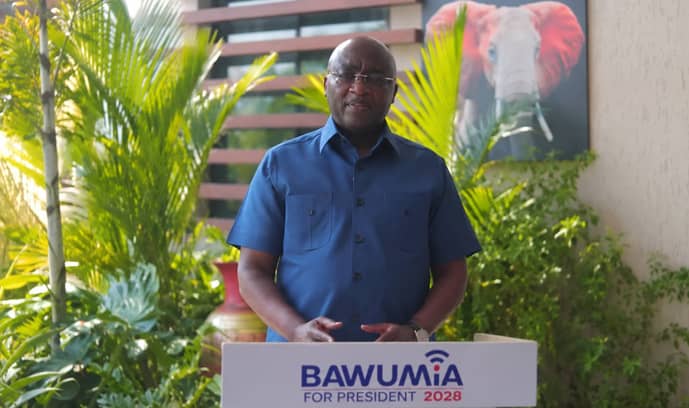
Former Vice President Dr Mahamudu Bawumia has defended the introduction of Ghana’s Gold-for-Oil programme, saying the policy helped the country avert a potentially severe economic crisis at a time when foreign exchange shortages were threatening the supply of essential imports.
Dr Bawumia said Ghana’s economic difficulties were intensified by the combined effects of the COVID-19 pandemic, the Russia-Ukraine war and restricted access to international capital for emerging market economies.
Speaking in a video post, he said the country was experiencing a balance-of-payments crisis, characterised by insufficient foreign exchange to finance normal economic activities.
“I found the results of the crisis of the balance of payments,” he said, explaining that Ghana did not have enough foreign exchange “to undertake our normal economic activities as a country.”
According to him, the situation was further complicated by the conditions attached to Ghana’s then International Monetary Fund (IMF) programme, which restricted the Bank of Ghana’s ability to intervene in the foreign exchange market.
“We were given a maximum of $80 million a month that the central bank could use to support the cedi,” he said, stressing that the limit was inadequate relative to Ghana’s monthly demand for foreign exchange.
The NPP 2028 flagbearer said the resulting mismatch between demand and supply put sustained pressure on the cedi, with the currency depreciating almost daily.
“Because when demand exceeded supply, prices would go up,” he said, describing the pressure on the foreign exchange market as a major concern.
He said his concern deepened when he observed the economic crisis unfolding in Sri Lanka, where foreign exchange shortages had contributed to shortages of food and other essential goods.
“In Sri Lanka, people were out on the streets. They were facing similar foreign exchange constraints and there was shortage of food because you couldn’t pay for food,” he recalled.
It was against this backdrop, Dr Bawumia said, that he proposed using Ghana’s gold resources to meet part of the country’s oil import requirements.
“Why don’t we come up with the idea of gold for oil to start with, to exchange our gold for oil so that we get out of this foreign exchange constraint,” he said.
Dr Bawumia argued that the arrangement could reduce the pressure on scarce dollar reserves while ensuring that Ghana continued to secure petroleum products.
“This is the background of the Gold-for-Oil programme, which essentially saved us from a major crisis,” he stated.
He said without the ability to use gold to support oil imports, Ghana could have faced significantly worse fuel shortages.
“Because if we had not been able to pay for the oil, then we would have had bigger fuel shortages and so forth,” he said.
Dr Bawumia said the policy also drew greater attention to the strategic value of Ghana’s gold resources and eventually informed a broader approach to accumulating gold as part of the country’s reserves.
He maintained that the experience demonstrated the need for policymakers to consider unconventional solutions when conventional sources of foreign exchange are severely constrained.







![The GoldBod Policy: A Bane, Not a Gain – Policy Analyst [FEATURE]](https://sikamantimes.com/wp-content/uploads/2025/03/Gold-Bars-75x75.jpeg)