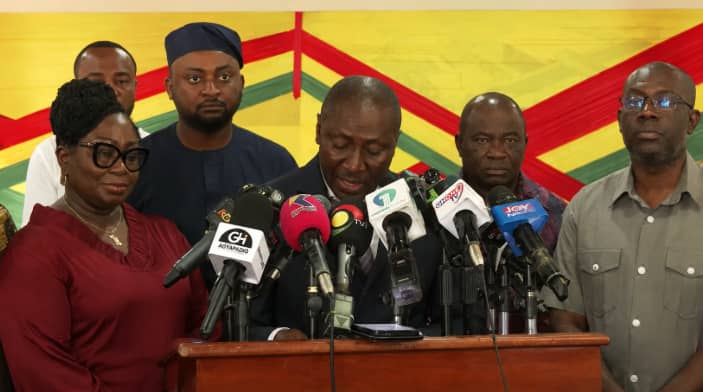
The Minority in Parliament has called for a full investigation into reported losses of about GH¢22 billion arising from Ghana’s domestic gold purchasing programme, with Minority Leader Alexander Afenyo-Markin insisting that the Ghana Gold Board (GoldBod) must account for its role in the transactions.
Addressing a press conference, Mr Afenyo-Markin said the Minority’s concerns were not about GoldBod’s reported profitability but about losses allegedly incurred through transactions conducted on behalf of the Bank of Ghana (BoG).
He argued that GoldBod could not claim the benefits of the programme while the associated financial risks and losses were reflected on the central bank’s books.
“The accounting location of a loss does not change its economic reality,” he said, arguing that the arrangement between GoldBod and BoG required deeper scrutiny.
According to the Minority Leader, the IMF’s latest assessment indicated that the domestic gold purchasing programme generated losses of US$1.67 billion, equivalent to about GH¢22 billion, in 2025.
He said the reported loss represented approximately 1.5 percent of Ghana’s GDP and about 17 percent of the value of the gold sold by BoG.
Mr Afenyo-Markin said the figures raised serious questions about pricing, fees, discounts granted to off-takers, risk allocation and the selection of companies involved in the transactions.
He said GoldBod participated in buying, aggregating, assaying and exporting gold, while BoG provided the financing and GoldBod earned fees from the transactions.
The Minority Leader questioned why GoldBod’s reported surplus should be regarded as proof that the broader gold trading operation was profitable when the financing institution allegedly absorbed substantial losses.
He also questioned whether appropriate risk controls and independent oversight were in place to protect public funds.
Mr Afenyo-Markin said the Minority would file a motion in Parliament seeking scrutiny of the programme and urged the Majority not to use its numerical strength to block an investigation.
He said Parliament had a responsibility to establish how the reported losses occurred and determine where commercial accountability rested.
The Minority Leader maintained that the issue was one of public accountability, insisting that the Ghanaian taxpayer ultimately bore the consequences of losses incurred through state-backed transactions.