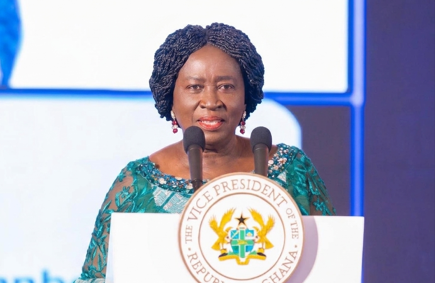
Vice President, Prof. Naana Jane Opoku-Agyemang, has called for stronger trust, ethical conduct and responsible use of technology in global financial markets, warning that resilient economies cannot be built on weak institutions and fragile market systems.
Addressing delegates on the second day of the 64th ACI World Congress in Accra, the Vice President said financial markets must ultimately serve people by creating opportunities, supporting enterprise and empowering societies.
“It is therefore worth noting that Ghana is the first Sub-Saharan African country after South Africa 17 years ago to host this World Congress,” she stated, describing the development as a reflection of “the growing importance of African financial markets and their expanding role in global market development.”
Speaking on behalf of President John Dramani Mahama, Prof. Opoku-Agyemang praised the role of the ACI Financial Markets Association in promoting professionalism, ethics and education in wholesale financial markets over the decades.
She noted that the congress theme, “Elevating Markets, Empowering People,” was a reminder that markets exist to mobilise capital, support enterprise, allocate resources and create opportunity, stressing that the people who build and regulate the systems must remain at the centre of financial development.
“The world is still adjusting to the aftershocks of inflation, higher interest rates, debt pressures, geopolitical tensions, climate risk, supply chain shifts and rapid technological disruption,” she said.
According to her, emerging and frontier economies continue to face serious pressures affecting exchange rates, fiscal planning, trade financing, debt sustainability and the cost of capital.
“We cannot build strong economies on weak markets. Resilient markets cannot be built without trust. And trust cannot exist without competence, ethics and robust institutions,” she stressed.
The Vice President further argued that discussions around financial markets should not only focus on instruments, yields and liquidity, but also on the people behind financial decisions and innovations.
“That is why we need professionals who understand their products and their purpose, manage risk with integrity, interpret data with discernment, and uphold conduct as the basis of the market’s credibility,” she said.
Prof. Opoku-Agyemang also highlighted the importance of investing in Africa’s youthful population, digital growth and entrepreneurial potential, saying deliberate efforts must be made to equip young people with the skills needed to participate in and shape future markets.
She warned that the growing use of artificial intelligence in finance presents both opportunities and risks.
“AI is reshaping how information is processed, risk is modeled, fraud is detected and decisions are made,” she noted, adding that while technology can improve efficiency and reduce costs, it also raises difficult questions about accountability and human responsibility.
“For countries like Ghana, the challenge is to build digital capacity while also building digital trust,” she said.
The Vice President said Ghana was working to deepen domestic capital markets, strengthen foreign exchange systems, improve payment infrastructure and expand local currency financing as part of efforts to create stronger and more transparent financial systems.
She also referenced the African Continental Free Trade Area, saying Africa’s future prosperity would not be built on fragmented markets.
Outlining key priorities for delegates, she urged stakeholders to strengthen trust, innovation and competitiveness through transparency and respect for rules, invest in the next generation of ethically grounded financial professionals, and ensure that AI and digital finance are used responsibly to support better decision-making.