Ghana’s economy grew by 6% in real terms in 2025, while multidimensional poverty declined from 31.2% in 2022 to 23% in 2025, according to the Ghana Statistical Service (GSS).
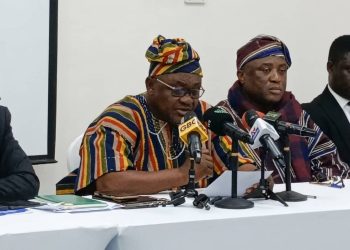
The figures are contained in the 2025 edition of Ghana in Numbers, presented by Government Statistician Dr Alhassan Iddrisu to provide an accessible overview of the country’s key economic, social, governance and environmental indicators.
The publication also showed that inflation declined to 5.4% at the end of 2025, from 54.1% in 2022, while the primary balance on a commitment basis improved from a deficit of 4.3% of gross domestic product (GDP) in 2022 to a surplus of 2.5% in 2025.
Ghana’s economy reached GH¢1.4 trillion in 2025, with GDP per capita standing at GH¢42,502, equivalent to US$3,385.
Presenting the findings, Dr Iddrisu said the publication brought together the country’s most important official statistics in simple language to support evidence-based decision-making.
“Good decisions begin with facts,” he said, adding that the figures showed where Ghana was making progress, the groups and communities being left behind, and areas requiring further action.
“Ghana is making progress, but not everyone feels it equally,” he said.
Poverty and living conditions
The report indicated that Ghana’s population reached 33.7 million in 2025, with almost six in 10 people living in towns and cities.
Life expectancy increased from 40.3 years in 1960 to 65.1 years, while maternal mortality declined from 485 deaths per 100,000 live births in 2010 to 301 deaths per 100,000 live births.
Multidimensional poverty, which measures deprivation across several aspects of life beyond income, also declined over the period under review.
Dr Iddrisu said the GSS could now measure multidimensional poverty across all 261 districts, providing data to help direct interventions towards communities that needed them most.
Food insecurity, however, remained a concern, affecting approximately 13 million people, representing 39.8% of the population, in 2025.
Although the figure represented a decline from 44.6% in 2022, the findings highlighted the continuing need for measures to improve food access and household welfare.
Trade surplus and business growth
Ghana recorded a merchandise trade surplus of GH¢148.3 billion, equivalent to US$11.5 billion, in 2025, as the value of goods exported exceeded imports by that amount.
The country also measured informal trade across its land borders for the first time, recording GH¢38.4 billion in goods traded over one year.
According to Dr Iddrisu, the value was approximately 1.4 times the trade recorded through customs, highlighting the scale of informal cross-border economic activity.
The GSS also reported that Ghana counted 2.64 million business establishments in 2024 during its first comprehensive business census.
The number of businesses and buildings had nearly tripled since 2014, while the jobs they provided had doubled.
However, nine in 10 establishments employed between one and five people, and only 7.7% were formally registered.
Women owned 84% of open-space businesses and managed 56.3% of establishments, while 32.7% of establishments used digital financial services.
The figures highlight the scale of Ghana’s entrepreneurial activity, alongside challenges relating to business formalisation, employment generation and the expansion of enterprises.
Unemployment and youth challenges
The report showed that unemployment declined to 12.8% in 2025, from 14.6% in 2023.
However, more than 70% of jobs remained informal, while nearly two million young people aged 15 to 35 were not working, studying or receiving training.
More than six in 10 young people in that category were women.
The findings point to the need for policies that expand employment opportunities, strengthen skills development and improve young people’s access to education, training and decent work.
Governance and environmental concerns
The GSS reported improvements in some governance indicators, with the proportion of people who felt they had no say in government decisions declining from 59.9% in 2013 to 29.7% in 2025.
The proportion of people reporting gifts to public officials also fell from 26.7% in 2021 to 16.8% in 2025.
However, women held 14.9% of seats in Parliament, despite accounting for 48.6% of High Court judges.
Environmental indicators also raised concerns about changes in forest distribution and rising coastal plastic pollution.
The share of forest reserves in the Savannah zone increased from 6.5% in 1990 to 14.9%, making it the zone with the largest share, while the Western North Region’s share declined from 19.6% to 6.5%.
Coastal plastic pollution reached 152.13 million items per square kilometre, more than four times the level recorded in 2016.
Dr Iddrisu stressed the importance of environmental protection, noting that safeguarding nature also protected food security, jobs, public health and the country’s future.
Call for evidence-based decisions
Dr Iddrisu urged government, district assemblies, Parliament, businesses, civil society organisations, researchers, the media and development partners to use the statistics to guide decisions and improve accountability.
He called on the government to use the data in preparing budgets and designing programmes, while district assemblies were encouraged to rely on local evidence to address community-specific challenges.
Parliament was urged to demand clear targets, while businesses were encouraged to use the data to create jobs, develop skills and add value.
He also called on citizens, researchers, the media, civil society and development partners to ask informed questions and hold institutions accountable.
“A statistic has value only when it improves the decision and ultimately improves life,” Dr Iddrisu said.